Choose the AI, speech and voice stack that fits your deployment
Start with HuskyVoiceAI’s recommended stack or, where supported, configure the models, speech providers, voices and languages that best fit your market, workflow, latency and enterprise requirements.
STT · Audio enhancement
Language · Intent · Context
LLM · Tool use · Guardrails
TTS · Voice · Locale
Cross-language workflows
One intelligence stack across every calling mode
The same model and speech foundation can power autonomous conversations, live human assistance and intelligence around human-led calls.
AI Voice Agent
Speech, reasoning and voice models work together to run an autonomous conversation.
AI Voice Copilot
Transcription, context and reasoning help AI assist a human during a live call.
Human-Led Calling
Speech and language models work around human conversations for transcription, translation and intelligence.
A voice conversation depends on more than one model
Listening, language understanding, reasoning, voice generation and translation solve different parts of the conversation.
Speech-to-text & audio
Turn caller audio into usable text while handling accents, languages and real-world call conditions.
Language & context
Interpret what the caller is saying in the context of the conversation, workflow and language being used.
LLMs & tool use
Use the reasoning layer to manage conversation flow, decide next steps and interact with connected tools.
Voices & text-to-speech
Turn AI responses into natural speech using voices suited to the language, market and deployment.
Cross-language workflows
Use translation where configured to help conversations and call records move across languages.
Use our recommended stack or configure your own
Start quickly with HuskyVoiceAI defaults, or use a custom provider architecture when your deployment has specific language, enterprise, latency, cost or procurement requirements.
Faster path to production
Use HuskyVoiceAI’s recommended provider configuration for your language, market and workflow.
More control over the provider architecture
Configure supported model, STT, TTS or audio providers around your enterprise or market requirements.
Custom model, speech, voice and provider configurations are available where technically supported and based on deployment requirements.
Built for multilingual and mixed-language conversations
Choose speech, language and voice configurations based on the way your customers actually speak — including multilingual and mixed-language conversations.
Language recognition
Use speech and language configurations suited to the caller and market.
Multilingual transcription
Turn spoken conversations into usable text across supported languages.
Translation
Translate conversation records or workflow information where configured.
Localized voices
Use voices suited to the language, locale and caller experience.
Choose how your AI sounds in every market
Explore voices by language, accent and style, preview how they sound, and configure the voice experience for different agents, markets and customer conversations.
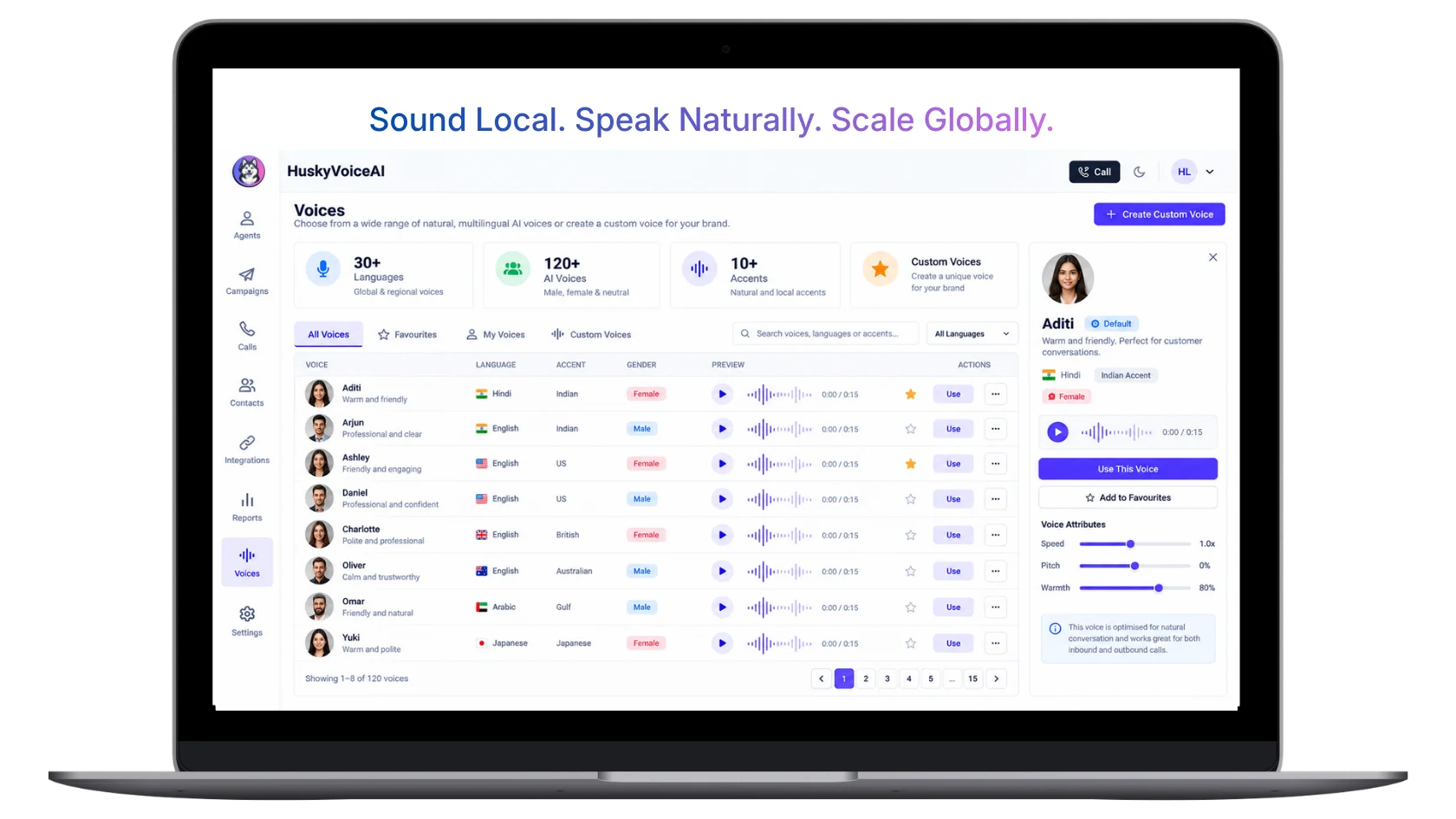
Choose a voice that fits the market and use case
Voice selection is part of the customer experience. Different deployments may need different language, locale, style, quality or latency characteristics.
Language & locale
Choose voices aligned to the language and market being served.
Voice style
Select from available voices and styles that fit the use case.
Naturalness
Balance expression and caller experience with realtime response needs.
Latency
Choose provider and voice configurations suited to live conversation speed.
Pronunciation
Use language and voice choices appropriate for names, locations and domain vocabulary.
Brand fit
Use the voice experience that best represents the intended agent persona.
Provider choice
Select supported TTS providers where deployment requirements call for it.
Market variation
Use different voices across languages, agents, regions and workflows.
Choose providers for the job each layer needs to do
Provider choice should follow the conversation requirements — not the other way around.
Reasoning & AI
Models for conversation reasoning, context, planning and tool-aware workflows.
Speech-to-text
Speech recognition and transcription for live and post-call conversation processing.
Text-to-speech & voices
Voice generation for natural, low-latency and multilingual AI conversations.
Audio enhancement
Noise handling and speech clarity for real-world phone environments.
Provider availability and configuration can vary by language, use case, geography, plan and technical deployment.
Different conversations need different model choices
The right stack depends on who is calling, how they speak, what the conversation needs to accomplish and how quickly the system needs to respond.
Indian clinic receptionist
Prioritize Indian-language accuracy, mixed-language conversations, pronunciation and responsive appointment workflows.
US sales qualification
Prioritize reasoning quality, CRM context, tool use, low latency and a natural English voice experience.
Recruitment screening
Prioritize transcription accuracy, structured candidate capture, scheduling and follow-up.
Multilingual support
Prioritize language recognition, multilingual transcription, translation and language-aware responses.
Noisy field calls
Prioritize audio clarity and reliable speech recognition before downstream reasoning.
Human-led conversations
Prioritize recording, transcription, translation, summaries and post-call intelligence rather than synthetic speech.
Configure for real-world reliability, not just model quality
Realtime voice operations need to balance model quality with latency, language accuracy, provider availability, escalation and operational visibility.
Provider fallback
Use fallback or alternate provider strategies where configured and technically supported.
Agent-level configuration
Use different model, speech or voice configurations for different agents, languages, regions or workflows.
Latency tuning
Balance model quality, response speed, transcription accuracy, voice quality and cost.
Language-specific tuning
Use provider and voice combinations suited to the language, accent or market being served.
Human escalation
Bring a person into the conversation when uncertainty, sensitivity or business rules require it.
Operational visibility
Review conversation outcomes, transcripts, model behavior and workflow completion.
Models power the conversation. The platform turns it into business value.
Conversational Intelligence
Turn AI-led and human-led conversations into transcripts, translations, summaries, outcomes and structured business data.
Workflows & Integrations
Connect conversation outcomes to CRM, calendars, WhatsApp, email, APIs and the work that needs to happen next.
Control how the model stack is used
Configure providers, model behavior, tool access, fallback and escalation around the needs of each calling workflow.
Provider selection
Choose providers based on language, geography, latency, cost, voice quality and business requirements.
Per-agent configuration
Configure different stacks for different agents, markets, languages and call types.
Allowed tools & actions
Control what the reasoning layer can access and which business actions it can trigger.
Fallback behavior
Define alternate provider, retry or escalation behavior where supported.
Human escalation
Move sensitive, uncertain or high-value conversations to people when appropriate.
Data handling review
Review how information flows through selected model, speech and voice providers in your deployment.
From model selection to real conversations
Choose recommended or custom
Start with HuskyVoiceAI defaults or define a provider architecture for your deployment.
Select languages & voices
Choose the languages, locales and voice experience required for your callers.
Configure model behavior
Set prompts, context, tool access, workflow rules and escalation behavior.
Test real calls
Evaluate transcription, latency, reasoning, pronunciation, voice quality and workflow completion.
Tune & monitor
Adjust providers and configuration based on language, reliability, quality, cost and operating needs.
Questions about Models, Voices & Languages
What does Models, Voices & Languages mean in HuskyVoiceAI?+
It is the platform layer behind speech recognition, AI reasoning, voice generation, multilingual conversations, translation and audio quality. HuskyVoiceAI can use recommended provider configurations or custom provider setups where supported.
Does this platform layer support AI Voice Agent, AI Voice Copilot and Human-Led Calling?+
Yes. AI Voice Agent uses speech, reasoning and voice models to run autonomous conversations. AI Voice Copilot uses transcription, context and reasoning to assist people during live calls. Human-Led Calling can use recording, transcription, translation and conversational intelligence around human conversations.
Which model and voice providers does HuskyVoiceAI support?+
HuskyVoiceAI supports providers including OpenAI, Anthropic, Sarvam, Cartesia, ElevenLabs, Deepgram and Krisp across different model, speech, voice and audio roles. Availability depends on deployment, language, geography and technical configuration.
Can we bring our own LLM?+
Custom or Bring Your Own LLM configurations can be supported on appropriate custom deployments where technically supported. This can help align with provider preferences, procurement requirements or enterprise architecture.
Can we use our own speech-to-text provider?+
Custom speech-to-text or transcription providers can be supported where technically appropriate. Provider selection can depend on language, accent, call quality, domain vocabulary and latency requirements.
Can we choose a different text-to-speech provider or voice?+
Yes, where supported. Voice configuration can be selected based on language, locale, brand fit, latency and caller experience.
Does HuskyVoiceAI support multilingual conversations?+
Yes. HuskyVoiceAI supports multilingual voice workflows and can be configured for different languages, locales and mixed-language conversations depending on the provider stack and deployment.
Can HuskyVoiceAI handle Hindi and Hinglish?+
Yes. HuskyVoiceAI can be configured for Hindi, Hinglish and other supported Indian-language workflows using appropriate speech and language providers.
Can HuskyVoiceAI translate conversations?+
Translation can be included where configured, including translated conversation records or workflows that need information to move between languages.
Can we use different providers for different agents or countries?+
Yes, where supported. Different agents, languages, regions or workflows can use different model, speech, voice or audio configurations.
Can the stack be optimized for latency or cost?+
Yes. Provider and configuration choices can be evaluated based on response speed, speech accuracy, voice quality, language requirements, regional availability and cost.
What happens if a model or speech provider is unavailable?+
Fallback behavior depends on the deployment. Alternate provider, retry, routing or human escalation strategies can be configured where technically supported.
Build the voice stack around your callers, not the other way around
Tell us the markets, languages, call types and AI requirements you are working with. We’ll map the model, speech and voice configuration that fits the deployment.
BOOK A PERSONALIZED DEMO
Show us your language and model requirements
We’ll map the AI models, speech providers, voices, languages and provider architecture that fit your deployment.