AI screens the candidate. Your recruiter picks up the conversation.
AI calls candidates in their language, asks your screening questions and captures the answers. When a recruiter follows up, the screening history, summary and next step are already there.
English · Hindi/Hinglish · Kannada · Tamil · Telugu · Marathi · Gujarati · Malayalam · Punjabi · Bengali
AI handles repetitive conversations. Recruiters stay in control of hiring decisions.
AI Screening Complete
Recruiter-ready candidate context
Relevant customer-support experience. Interested in the role and available for the next round.
How HuskyVoiceAI Works
See how one candidate call becomes an interview workflow.
The AI screens the candidate, shares the JD, captures availability, and updates the recruiter.
Calling…
AI recruiter is reaching the candidate
AI + HUMAN RECRUITMENT CALLING
Three ways to screen and engage candidates
Choose how each conversation happens without losing the candidate's screening history.
AI Phone Screening
Automatically call candidates, ask recruiter-approved questions and capture structured screening responses.
Web-Link Interviews
Let candidates open a URL and complete a voice screening conversation from their browser.
Recruiter-Led Calls
Recruiters manually call candidates with earlier screening context available before the conversation starts.
SHARED CANDIDATE CONTEXT
Every candidate conversation builds on the previous one
AI phone screening, browser-based interviews and recruiter-led calls can all contribute to one evolving candidate history.
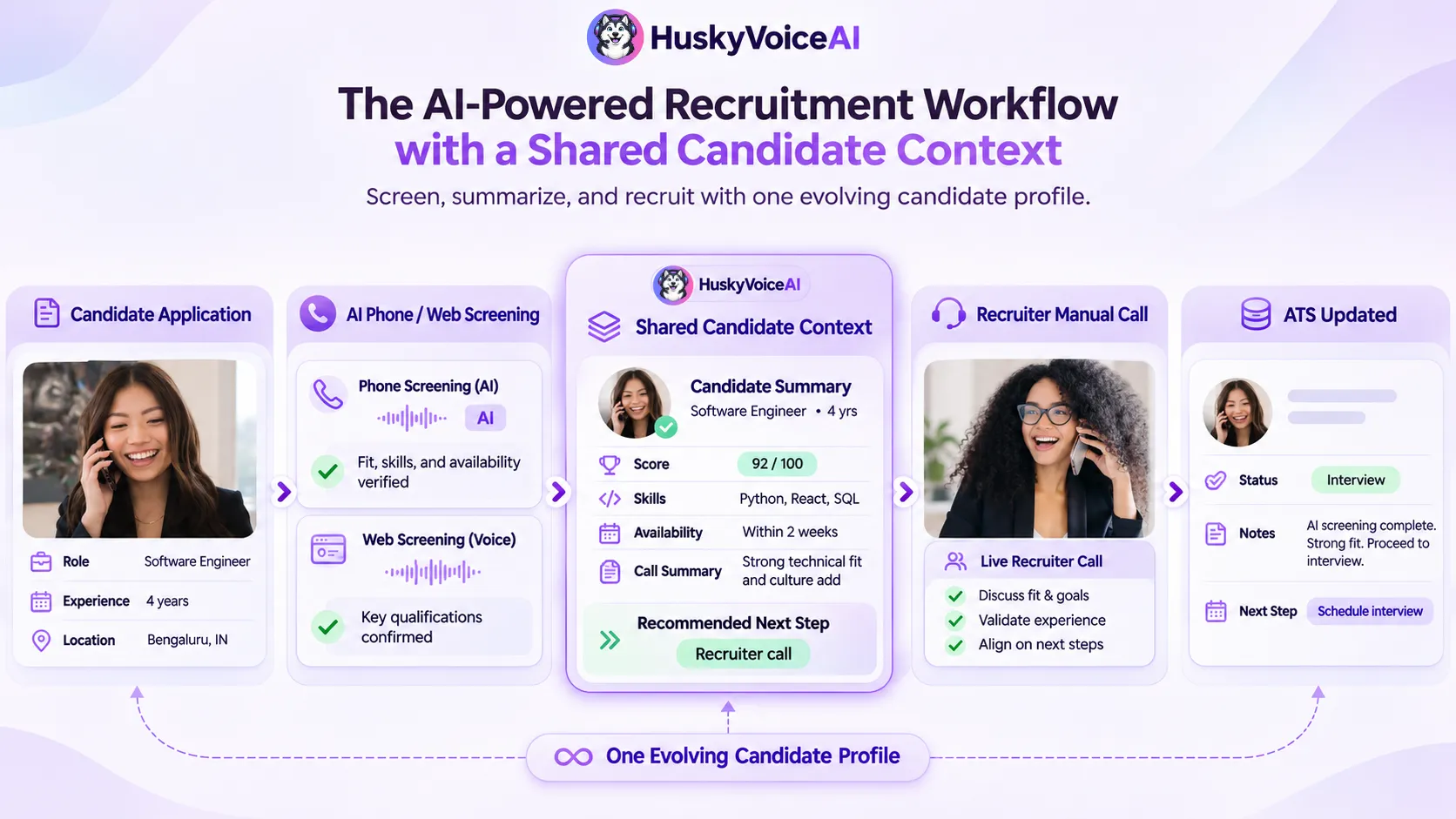
Screening answers, experience, role interest, notice period, availability and other recruiter-approved fields.
Recruiters review the earlier screening history before calling, so they do not need to restart the conversation from zero.
The latest recruiter notes, call outcome and next action can be returned to the connected ATS or hiring workflow where supported.
Recruitment workflows
Automate screening, scheduling and follow-up
Start with the repetitive candidate conversations where speed and consistency matter most.
Initial candidate screening
Call candidates and ask consistent screening questions before recruiters spend time on manual first-round calls.
Recruiters receive qualified candidates with context, not just a list of names to call.
Interview scheduling
Reduce back-and-forth by using voice calls to confirm candidate availability and coordinate interview slots.
Recruiters spend less time coordinating calendars and more time interviewing the right candidates.
Reminder & no-show follow-up
Use AI voice reminders to confirm attendance, recover no-shows, and understand why candidates drop off.
Hiring teams get faster visibility into candidate intent and fewer silent drop-offs.
How it works
How AI and human recruitment calls work together
Use the right operating mode for each stage of the candidate journey while keeping the information connected.
Start from your candidate list or ATS
A candidate enters through a job application, ATS, spreadsheet, recruitment campaign, or API.
Choose how screening happens
The AI can call the candidate, or the candidate can complete a voice interview through a screening URL.
Capture structured responses
Record role interest, experience, notice period, expected compensation, location, availability, and recruiter-approved questions.
Share context with the recruiter
A recruiter can review the screening history and make a manual follow-up call without repeating questions unnecessarily.
Update the hiring workflow
Store the latest call outcome, summary, recruiter notes, and next actions. Send agreed information to the ATS where the integration supports it.
Candidate call workflow
One call can move a candidate from interest to recruiter review.
HuskyVoiceAI can collect the information your recruiter needs, identify the next workflow step, and return a clean record after the conversation.
Candidate call workflow
Interest
Candidate confirms role interest and availability.
Screen
Experience, skills, location, notice period, and compensation are captured.
Schedule
Interview availability or reschedule request is collected.
Handoff
Recruiter gets summary, transcript, and recommended next step.
Call
Status
Fit
Signal
ATS
Ready
Recruiter-ready output
Every call becomes structured hiring context.
Recruiters shouldn't have to replay every conversation or manually type call notes. HuskyVoiceAI can return structured answers, summaries, transcripts, recordings, and the recommended next workflow step.
The AI helps collect and organize information. Recruiters continue to decide who advances.
Example screening summary
Integrations
Connect AI and human candidate calls to your ATS.
Trigger calls from your existing process and send outcomes back to the systems recruiters already use.
Global-ready
Built for modern hiring across markets.
Use the same calling workflows across distributed, multilingual, shift-based and high-volume hiring teams.
Start small
Start with one measurable recruitment workflow.
You do not need to automate the entire hiring journey on day one. Start with one repetitive workflow, measure the impact, and expand.
Outcomes
Improve the speed and consistency of candidate engagement.
Who uses it
For teams that need to reach candidates at scale.
Trust, security & control
Designed for recruiter handoff, not black-box hiring decisions.
HuskyVoiceAI helps collect structured candidate information and automate repeatable conversations. Final hiring decisions, sensitive discussions, offers and exceptions remain with your recruitment team.
CHOOSE THE RIGHT OPERATING MODE
Automate the repetitive calls. Keep recruiters on the conversations that need them.
Not every candidate conversation should be automated. Use AI for repeatable qualification and coordination, and use recruiters for judgment, relationship-building and sensitive conversations.
AI Voice Agent
AI screens, qualifies, schedules and follows up automatically.
AI Voice Copilot
A recruiter leads the conversation while AI assists with context, notes and next steps.
Human-Led Calling
Recruiters make the call while Husky captures the conversation, summary and workflow outcome.
Recruitment workflow cluster
Go deeper into specific recruitment workflows.
Candidate screening, scheduling, staffing outreach, follow-ups and verification can each be configured as separate Voice AI workflows.
AI Candidate Screening Calls
Automate first-round candidate screening calls, role-fit questions, availability checks, and recruiter-ready summaries.
Explore workflowAI Interview Scheduling Calls
Call candidates to confirm availability, collect preferred slots, send reminders, and handle reschedule requests.
Explore workflowVoice AI for Staffing Agencies
Scale candidate outreach, screening, availability checks, and recruiter handoffs for staffing and recruitment firms.
Explore workflowAI Recruitment Follow-up Calls
Automate document reminders, post-interview follow-ups, offer follow-ups, joining confirmation, and candidate reactivation.
Explore workflowBackground Verification Calls
Use AI voice calls for verification workflows, status checks, structured responses, and recruiter or operations handoff.
Explore workflowFAQ
Frequently asked questions.
Ready to improve candidate calls?
Start with one candidate conversation and connect the next step.
See how HuskyVoiceAI can screen candidates, coordinate interviews, handle reminders and follow-ups, and return recruiter-ready call summaries.