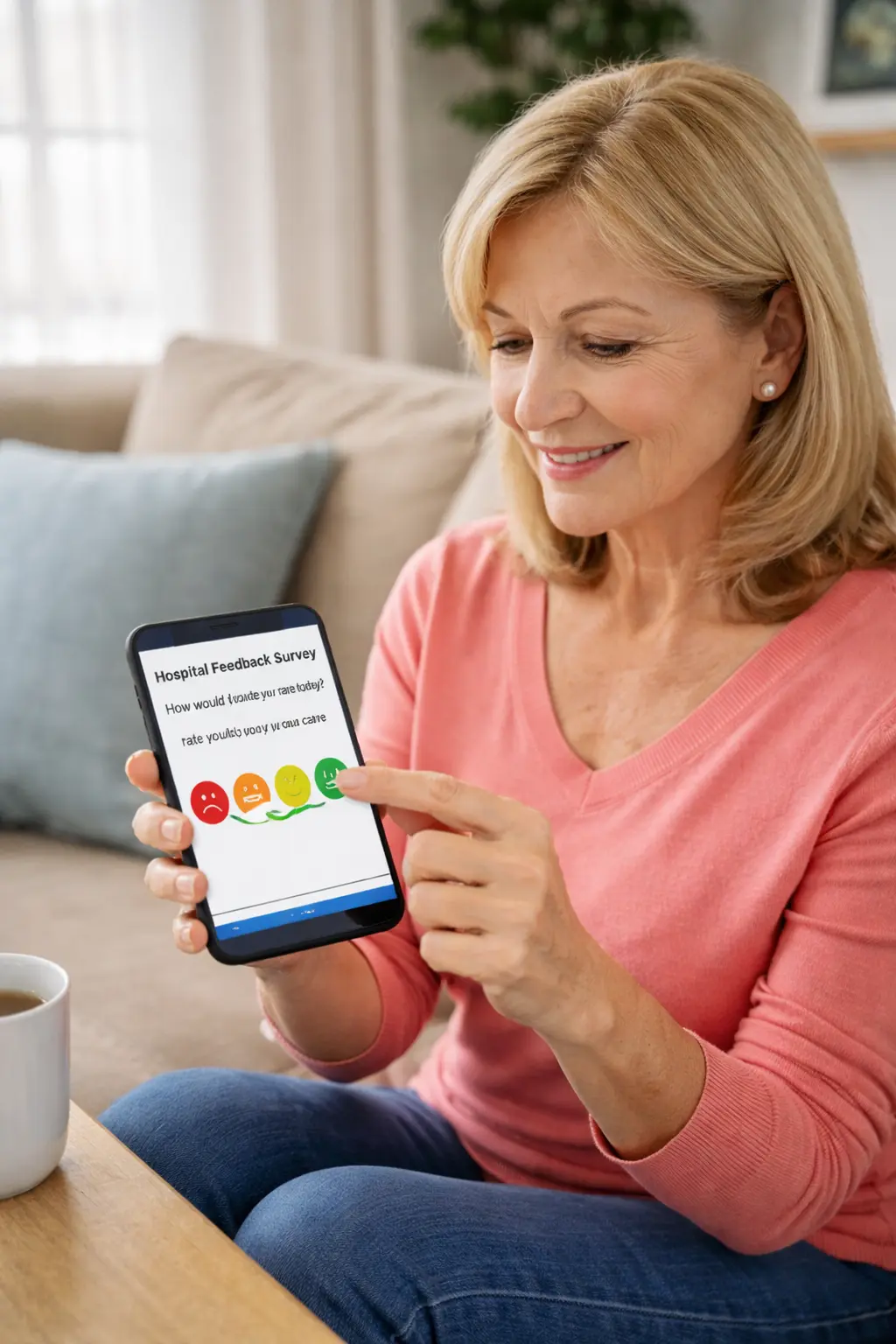
Hospitals often talk about patient experience, patient satisfaction, and NPS as if they mean the same thing. They do not. Each one measures something different, and each one is useful in a different way. AHRQ distinguishes patient experience from patient satisfaction, while CMS positions HCAHPS as a standardized, publicly reported survey of hospital patients’ perspectives of care.
For hospitals, this difference matters because the wrong metric can lead to the wrong conclusion. A hospital may have decent satisfaction scores but still have communication gaps. It may have a good recommendation score but still struggle with discharge clarity or nurse responsiveness. And it may run internal phone feedback calls without complying with the formal methodology required for HCAHPS reporting.
For HuskyVoiceAI, this distinction is actually an opportunity. Formal surveys like HCAHPS are important for benchmarking and structured reporting. But hospitals also need faster, operational feedback loops to collect ratings, reasons, complaints, and improvement suggestions soon after a visit or discharge. That is where Voice AI over phone can help. This is an operational recommendation rather than an official replacement for HCAHPS methodology.
What is HCAHPS?
HCAHPS stands for the Hospital Consumer Assessment of Healthcare Providers and Systems survey. CMS describes it as a national, standardized, publicly reported survey of patients’ perspectives of hospital care. It uses a 32-item instrument and a defined methodology so hospitals can be compared on a common basis. CMS also states that the survey is administered to a random sample of adult patients between 48 hours and 6 weeks after discharge.
HCAHPS is designed for comparability. Its purpose is not just to gather internal feedback, but to produce standardized data that supports benchmarking and public reporting. CMS notes that hospitals must follow approved survey administration rules, and the survey can be administered by approved vendors or by hospitals that are approved to collect their own HCAHPS data.
In simple terms, HCAHPS is the structured, formal side of hospital feedback.
What is patient satisfaction?
Patient satisfaction is broader and more subjective. AHRQ explains that satisfaction measures whether the patient’s expectations were met, while patient experience focuses on whether certain events or behaviors actually occurred.
For example, a satisfaction survey may ask about:
- overall satisfaction
- waiting time
- staff courtesy
- billing experience
- cleanliness
- whether the patient felt well cared for
This makes patient satisfaction useful for internal service improvement, but less standardized than HCAHPS. Two hospitals may ask very different satisfaction questions, which makes direct comparison harder. That is one reason HCAHPS exists as a common national standard in the U.S.
What is NPS in hospitals?
NPS, or Net Promoter Score, is built around a recommendation question: how likely the patient is to recommend the hospital or provider to others. In healthcare, Press Ganey describes NPS as a metric that can reveal important insight into the relationship between patients and a healthcare brand, but it also notes that NPS is not the only measure needed for a complete understanding of experience.
Press Ganey also draws an important distinction between relationship NPS, which measures the overall relationship with the brand, and transactional recommendation questions, which are tied to a specific encounter or process. That distinction matters in hospitals, because “would you recommend this hospital?” is not always the same as “how was this specific visit?”
In practice, NPS is useful because it is short and leadership-friendly. But by itself, it does not explain what went wrong or what to fix.
The simplest way to understand the difference
Here is the easiest way to think about these three approaches:
HCAHPS asks for a standardized view of the inpatient hospital experience. It is formal, structured, and benchmarkable.
Patient satisfaction asks whether the patient felt their expectations were met. It is more flexible, more subjective, and usually designed by the hospital or vendor.
NPS asks whether the patient would recommend the organization. It is fast, simple, and useful for tracking loyalty or relationship strength, but it is not a complete experience program on its own.
Why hospitals should not treat them as interchangeable
A hospital can score well on one and still have issues on another.
For example, a patient might say they were generally satisfied because the doctor was good, but still report poor communication about medications or discharge instructions. That would show up more clearly in an experience-based framework like HCAHPS than in a generic satisfaction question. CMS and AHRQ both frame HCAHPS/CAHPS around patient perspectives on specific care experiences, which is why they are used in quality improvement and comparison programs.
Similarly, a hospital may have a decent NPS trend because overall brand trust is strong, but still have operational issues in a department such as diagnostics, emergency, or billing. Press Ganey specifically notes that a relationship NPS metric is different from evaluation of a specific care event.
So the metrics answer different questions:
- HCAHPS: What was the patient’s experience during the inpatient stay?
- Patient satisfaction: How satisfied was the patient overall?
- NPS: Would the patient recommend us?
When hospitals typically use each one
Hospitals use HCAHPS when they need standardized inpatient feedback and public reporting alignment. CMS states that HCAHPS is publicly reported and standardized for valid comparisons across hospitals.
Hospitals use patient satisfaction surveys when they want flexible internal feedback for OPD, diagnostics, emergency, billing, front desk, or specific service lines. AHRQ’s distinction makes this category especially useful for internal service improvement, even though it is less comparable across institutions.
Hospitals use NPS when they want a short recommendation-based metric for leadership dashboards, patient loyalty tracking, or private healthcare brand measurement. Press Ganey’s healthcare guidance supports this use, while also cautioning against relying on NPS alone.
Where Voice AI fits
Voice AI is not a replacement for formal HCAHPS methodology. If a hospital wants official HCAHPS reporting, it must follow CMS rules and approved administration processes.
But Voice AI is a strong fit for the operational layer around these programs.
For example, hospitals can use Voice AI to:
- run short post-discharge feedback calls
- collect patient satisfaction ratings over phone
- ask an NPS-style recommendation question and then capture the reason
- identify unhappy patients quickly
- escalate service-recovery calls to human teams
- support multilingual outreach across English and regional languages
That makes Voice AI especially useful where hospitals need speed, reach, and context, rather than formal public-reporting compliance.
A practical model for hospitals
A more realistic hospital feedback stack looks like this:
- HCAHPS or equivalent formal patient experience process for standardized measurement
- short satisfaction calls for day-to-day operational feedback
- NPS-style question for leadership trend tracking
- service-recovery callback for low ratings or complaints
This layered approach is more useful than forcing one metric to do everything. It gives the hospital both structured benchmarking and fast operational action. CMS and AHRQ support the quality-improvement role of CAHPS-type surveys, while healthcare experience vendors position NPS as a complementary rather than standalone metric.
How HuskyVoiceAI can help
HuskyVoiceAI can help hospitals modernize the operational part of feedback collection through natural phone-based outreach.
For example, a hospital can use HuskyVoiceAI to:
- call patients after discharge
- ask a short rating question
- capture why the patient gave that rating
- identify whether a call back is needed
- summarize the feedback for the hospital team
- route negative responses for quick action
This is especially useful for hospitals that want a more conversational alternative to SMS-only surveys or rigid IVR flows. The product position here is operational efficiency and patient follow-up, not formal HCAHPS replacement.
Final takeaway
HCAHPS, patient satisfaction, and NPS are all useful, but they are not the same.
HCAHPS is a formal, standardized patient experience survey used for comparison and public reporting.
Patient satisfaction is a broader, more subjective measure of whether expectations were met.
NPS is a short recommendation-based metric that can be helpful for tracking loyalty or brand relationship, but should not be treated as a complete picture by itself.
For HuskyVoiceAI, the most credible and useful position is clear: help hospitals improve the operational side of patient feedback with natural, multilingual phone surveys and faster service-recovery workflows.
FAQ
Is HCAHPS the same as patient satisfaction?
No. AHRQ distinguishes patient experience from patient satisfaction. HCAHPS is a standardized patient experience survey, while satisfaction reflects whether expectations were met.
Do hospitals use NPS?
Yes. Many hospitals and healthcare organizations use NPS-style recommendation questions, but healthcare experience experts caution that NPS should complement, not replace, broader experience measurement.
Can Voice AI be used for hospital patient surveys?
Yes, for operational feedback calls such as post-discharge follow-up, satisfaction capture, NPS-style outreach, and service recovery. It should not be framed as a substitute for formal HCAHPS reporting methodology.