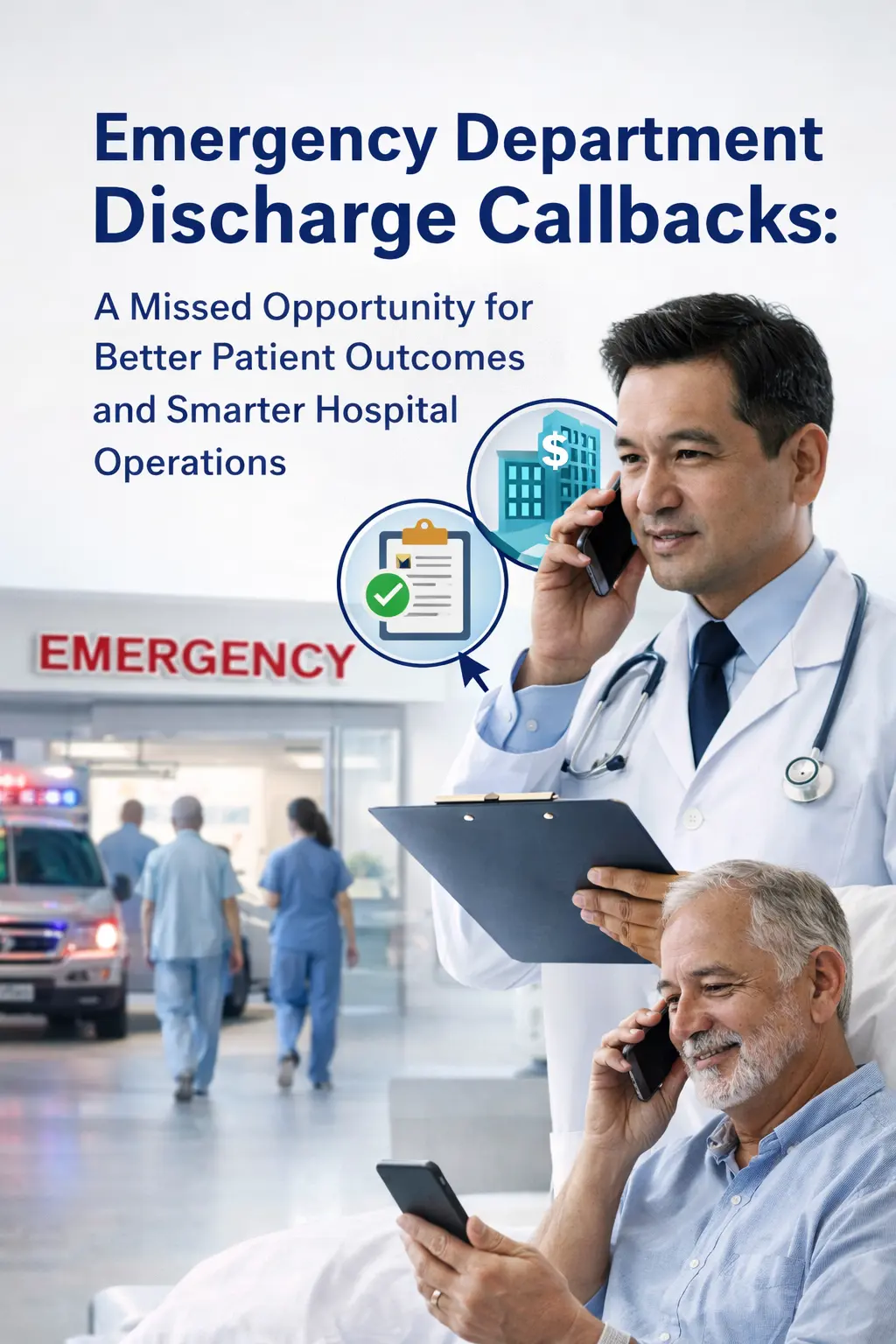
Emergency departments are designed to stabilize, treat, and discharge patients quickly. But for many patients, the most fragile part of the emergency care journey begins after they leave. Once they get home, questions emerge. Symptoms change. Discharge instructions are forgotten. Medication confusion sets in. Follow-up appointments are missed. And when that happens, the emergency department often becomes the place patients return to, not because the original treatment was necessarily wrong, but because the transition out of care was incomplete. AHRQ’s discharge toolkit explicitly frames post-discharge phone calls as a way to uncover patient questions, misunderstandings, and discrepancies in the discharge plan, and CMS’s ED CAHPS survey is designed specifically for adults discharged home from hospital-based emergency departments, underscoring how important the post-ED period is to patient experience.
That is why emergency department discharge callbacks deserve more attention than they usually get. In many hospitals, the callback is treated as a nice-to-have courtesy, delegated to already-stretched staff or omitted entirely when volumes spike. But that view is too narrow. A discharge callback is not just a patient satisfaction exercise. It is a care-transition tool, a patient safety tool, a service-recovery tool, and an operational intelligence tool all at once. AHRQ’s RED toolkit recommends calling patients within three days of discharge to reinforce the discharge plan and help with problem solving, while PSNet describes a case where a post-discharge phone call surfaced worsening symptoms and likely prevented a return ED visit and possible readmission.
The strategic mistake many hospitals make is thinking about ED discharge callbacks as if they were merely a manual outreach task. In reality, they are a workflow. And workflows scale only when they are designed intentionally. As emergency departments continue to manage high throughput, variable acuity, staffing pressure, and growing patient expectations, the question is no longer whether post-discharge callbacks are useful. The question is how hospitals can make them consistent, fast, and actionable without adding unsustainable manual burden. Recent 2026 healthcare AI and contact-center coverage reflects that broader shift toward automating high-volume patient communication workflows such as follow-up, refill, and billing interactions, while preserving human oversight where complexity or risk is higher.
Why ED discharge is operationally different from general hospital discharge
Emergency department discharge is not the same as inpatient discharge. The patient is often seen quickly, treated episodically, and sent home without the longitudinal support structure that accompanies an admission. Many are discharged after a period of uncertainty, stress, pain, or incomplete understanding. ED CAHPS exists for exactly this reason: CMS says it is designed for adults of hospital-based emergency departments who are discharged to home, also known as “treat and release” visits, which account for about 90% of all ED visits. AHRQ’s ED-focused survey guidance similarly treats the ED as a distinct patient-experience setting.
That distinction matters because the discharge risk profile is different. In the ED, the hospital often has less context, less continuity, and less certainty that the patient fully absorbed what came next. A patient may understand the diagnosis poorly, may not know which symptom is serious enough to act on, or may not have made the recommended follow-up appointment. AHRQ’s post-discharge phone call framework specifically includes diagnosis and health status, medicines, clarification of appointments, coordination of post-ED or post-hospital services, and review of what to do if the condition changes.
This is why the ED callback should not be framed as a courtesy call. It is a transition-of-care checkpoint.
The business case hospitals often overlook
Hospital leaders usually understand the emotional case for follow-up, but the business case is just as compelling. A callback can reduce unnecessary repeat contact, identify patients who are likely to deteriorate or return, surface discharge-process weaknesses, and create earlier service-recovery opportunities before dissatisfaction turns into complaints, poor reviews, or avoidable revisits. In the 2026 multicenter quasi-randomized trial across 12 acute-care hospitals in British Columbia, a routine operational post-discharge follow-up phone call was studied specifically for its effect on ED visits and hospital readmissions among high-risk patients, showing that hospitals are now evaluating discharge calls not just as a communications tactic but as an operational intervention.
Earlier evidence points in the same direction. A 2011 study found that timely discharge follow-up by telephone was associated with lower 30-day readmission rates, with intervention patients 23.1% less likely than the comparison group to be readmitted within 30 days. While that study was not ED-specific, it strengthens the broader argument that post-discharge phone follow-up can create measurable value beyond patient sentiment alone.
There is also an experience-management angle. A 2021 doctoral project reported that post-discharge calls to ED patients increased patient ratings for likelihood to recommend the hospital and/or ED. That is important because emergency care satisfaction is highly sensitive not only to clinical outcomes, but to whether patients feel informed, respected, and supported after they leave.
What a good ED discharge callback is actually trying to achieve
The purpose of a callback is not simply to ask, “How was your visit?” A good ED discharge callback does four things.
First, it checks comprehension. Does the patient understand the diagnosis, medication instructions, and what symptoms should trigger further action? AHRQ’s patient-version post-discharge script is built around exactly these questions.
Second, it checks continuity. Does the patient know whether a primary care or specialist follow-up is needed, and has that next step become real or remained abstract? AHRQ’s RED toolkit includes clarification of appointments and coordination of services as core components of the call.
Third, it checks risk. Is the patient feeling worse, confused, unable to obtain medicines, or showing signs that warrant escalation? PSNet’s example shows how follow-up calls can uncover clinical deterioration that might otherwise go unnoticed until the patient returns in worse condition.
Fourth, it checks experience. Did the patient leave feeling informed, respected, and cared for? CMS’s ED CAHPS and ED patient-experience research both reinforce that the discharged-to-community ED population has meaningful, measurable experience dimensions of its own.
That combination makes the callback one of the rare hospital workflows that simultaneously touches quality, operations, patient experience, and reputation.
Why many hospitals still underperform here
The answer is not lack of awareness. It is lack of operational design.
In many hospitals, ED callbacks depend on whoever has time: a nurse, patient-relations staff member, care coordinator, or call-center team working from a static list. That creates inconsistency in timing, script quality, documentation, and escalation. Some patients are called too late. Some are unreachable. Some are asked generic questions that reveal little. Some mention an issue, but the issue never gets routed to the appropriate team. AHRQ’s own tools include structured documentation forms for post-discharge calls, which reflects the reality that follow-up is only as useful as the information captured and acted upon.
The second problem is that hospitals often use the same callback logic for all discharges. But ED discharges are a special category. The patient may never have built a relationship with the care team. The discharge may have happened during a stressful, crowded, or late-night encounter. And the probability of unresolved confusion is often higher than administrators assume. That is one reason ED-specific patient-experience instruments were developed in the first place.
The third problem is that even when callbacks happen, they are rarely integrated into a closed-loop workflow. A callback that discovers medication confusion but does not trigger pharmacist, nurse, or physician review is not a complete solution. It is just a recorded concern.
Why Voice AI changes the equation
This is where Voice AI becomes strategically important.
Traditional IVR can collect a number. Manual callbacks can collect nuance. Voice AI sits between those two extremes: it can scale like automation while still feeling conversational enough to collect context, ask follow-up questions, and determine whether a human should step in. Current healthcare voice-agent and contact-center coverage in 2026 repeatedly highlights that the strongest early use cases are high-volume, repeatable communication workflows where natural language matters but full clinical autonomy is neither required nor appropriate.
An ED discharge callback fits that profile extremely well. The workflow is structured, but not rigid. The hospital knows the patient has been discharged. It knows what department they visited. It usually knows the follow-up window. It may know the suspected diagnosis, medication instructions, and recommended next step. What it needs is a way to confirm understanding, capture concerns, and escalate when the patient sounds confused or at risk.
Voice AI can do that at scale:
- call within the correct post-discharge window,
- verify the patient,
- ask how they are feeling,
- check whether medicines and discharge instructions were understood,
- confirm follow-up awareness,
- capture experience feedback,
- and offer a callback from a human team when needed.
That is a much more meaningful use of automation than a rigid keypad tree.
The right model is not “AI replaces clinicians”
Hospitals should be careful here. Emergency department follow-up sits close to clinical risk, so the goal is not to replace nurses, doctors, or care coordinators with an autonomous voice layer. The goal is to use Voice AI as the first-pass transition workflow: the part that ensures every discharged patient receives a timely check-in, every concern is documented, and every serious signal is routed to the right human team.
That positioning is both safer and stronger. It matches the cautious-but-practical way hospitals are approaching generative AI more broadly. Recent reporting on hospital AI deployments shows growing confidence in AI for administrative and communication workflows, but also a clear emphasis on human oversight and the limits of unsupervised automation in healthcare.
In other words, the best ED callback model is:
- AI for consistency and reach
- humans for judgment and intervention
What an ideal ED discharge callback workflow looks like
A modern ED discharge callback program should be designed around a few operational principles.
1. Tight timing
The call should happen soon enough to catch confusion early. AHRQ’s broader discharge guidance recommends calling within three days of discharge, and other ED follow-up projects have used contact windows within 72 hours.
2. Short but purposeful scripting
The script should focus on a few high-value areas: current condition, medication understanding, follow-up awareness, unresolved concerns, and whether human help is needed. AHRQ’s patient-version script and documentation tools provide a strong foundation for these domains.
3. Risk-based escalation
If the patient reports worsening symptoms, inability to obtain medicines, persistent confusion, or a request for help, the workflow should immediately flag the appropriate team. PSNet’s example illustrates how clinically meaningful issues can emerge during a simple follow-up call.
4. Structured data capture
Hospitals should not just store transcripts. They should capture discrete fields such as symptom concern, medicine confusion, follow-up unclear, callback requested, and sentiment. AHRQ’s follow-up call documentation model supports that kind of structured capture.
5. Experience intelligence
The callback should not only identify safety risks; it should also capture where the ED journey broke down from the patient’s point of view. CMS’s ED CAHPS and ED patient-experience work show that discharged ED patients can and should be measured as a specific experience cohort.
The hidden leadership value: callbacks reveal system problems
One underappreciated benefit of ED callbacks is that they generate operational intelligence.
If patients repeatedly say they did not understand discharge instructions, that is not a patient problem. It is a discharge-process problem. If many callback patients say they could not get their medicines, that may indicate prescribing, pharmacy, or affordability friction. If they say they did not know whom to follow up with, the referral pathway may be unclear. If they say they were not informed while waiting, the issue may be communication discipline inside the ED rather than throughput alone.
This is where thought leadership matters. The ED callback should not be seen as the last step in a visit. It should be seen as the first post-visit feedback loop into operations. That is the mindset shift hospitals need.
Where HuskyVoiceAI fits
HuskyVoiceAI is well positioned for this use case because the product’s strengths align closely with what ED discharge callbacks require: natural phone interaction, multilingual capability, structured capture, and escalation to human teams.
A hospital could use HuskyVoiceAI to:
- place callbacks automatically within a defined ED discharge window,
- speak to patients in English or regional languages,
- ask a short, empathetic post-ED follow-up script,
- capture whether symptoms have worsened,
- confirm medication and follow-up understanding,
- collect an experience rating and reason,
- and route urgent or dissatisfied cases to patient relations, nursing, or physician review.
That is a high-value operational layer, especially for hospitals that want better coverage than manual calling can provide, but do not want to reduce the workflow to a lifeless IVR script.
The bigger picture
Emergency departments are under constant pressure to move patients safely, quickly, and efficiently. But speed at discharge should not come at the cost of continuity after discharge. The hospitals that get this right will not necessarily be the ones with the most staff making callbacks. They will be the ones that treat callbacks as a designed workflow: timely, structured, intelligent, and connected to action.
That is why emergency department discharge callbacks are a missed opportunity in so many hospitals today. They sit right at the intersection of patient safety, patient trust, and operational excellence. And because of that, they are exactly the kind of workflow where Voice AI can add real value — not by pretending to replace clinical care, but by making sure the hospital does not lose the patient the moment the patient leaves the ED. AHRQ’s discharge follow-up resources, CMS’s ED CAHPS framework, and emerging operational studies together make a strong case that the post-ED period is too important to leave unmanaged.
Want to see how ED discharge callbacks could work with Voice AI?
HuskyVoiceAI can help hospitals automate post-ED follow-up calls, check discharge understanding, capture patient concerns, and route callbacks to the right team faster.
FAQ
What is an emergency department discharge callback?
It is a follow-up phone call made after an ED patient is discharged home, usually to reinforce discharge instructions, check on symptoms, clarify medications, and identify whether additional help is needed. AHRQ’s discharge toolkit includes structured post-discharge phone call guidance for these purposes.
Why are ED discharge callbacks important?
They can uncover confusion, worsening symptoms, missed follow-up, and unresolved concerns early. CMS’s ED CAHPS and AHRQ’s discharge resources both show that the discharged ED population is an important post-visit cohort to engage.
Can Voice AI replace nurses or physicians in discharge follow-up?
It should be positioned as a first-pass workflow and escalation layer, not as a replacement for clinical judgment. Hospitals generally use AI most safely and effectively when it supports communication and triage while preserving human oversight for higher-risk decisions.
How soon should an ED discharge callback happen?
Hospitals commonly aim to call shortly after discharge. AHRQ’s broader discharge guidance recommends calling within three days, and some ED follow-up projects have used contact windows within 72 hours.