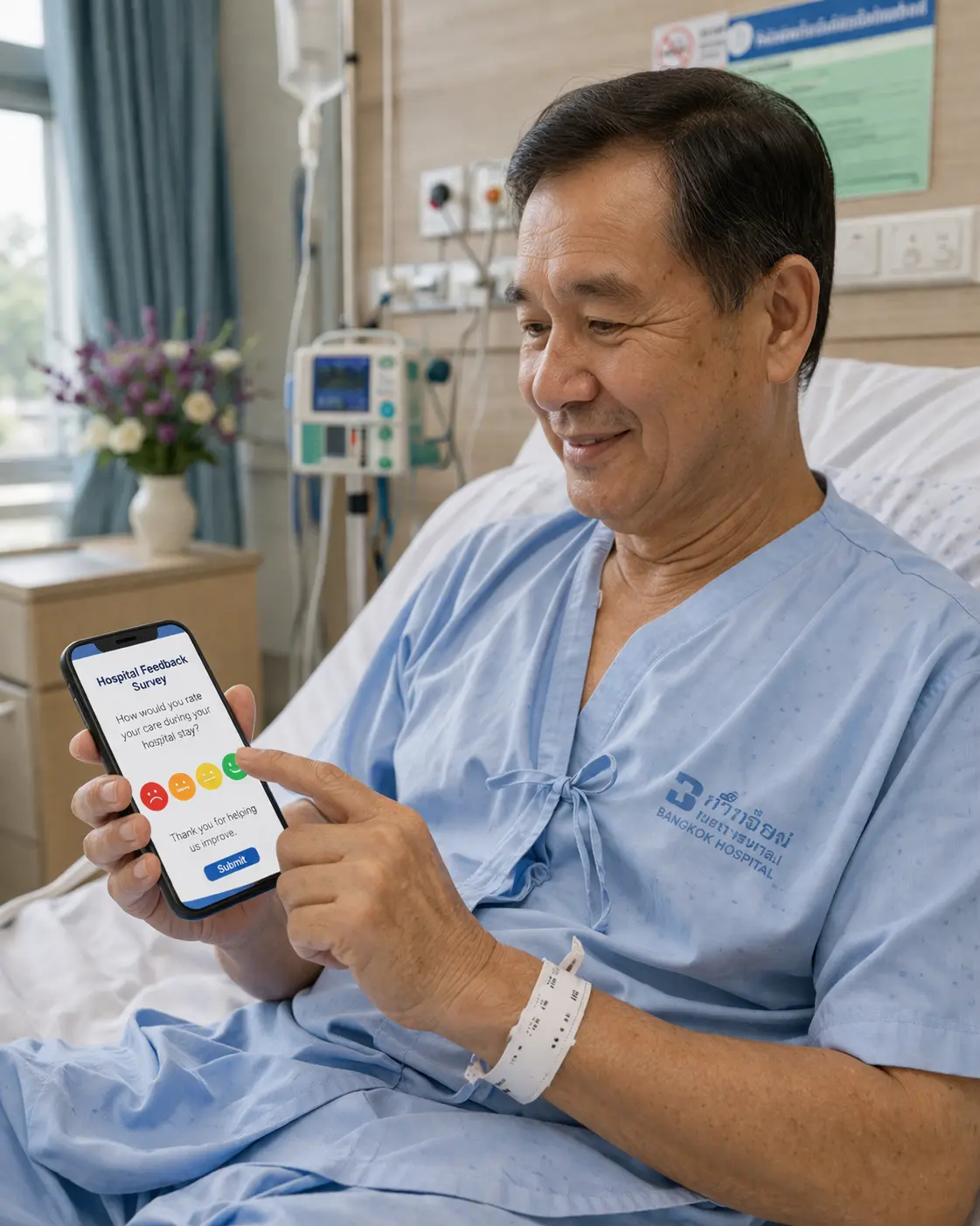
Hospitals should not use the same feedback questions for every patient interaction. A patient coming in for a quick diagnostic test does not experience the hospital the same way as an inpatient recovering after surgery or a family visiting the emergency department. AHRQ’s CAHPS survey family reflects this broader reality: survey design should match the care setting and the patient journey.
That is why the best patient feedback questions are usually setting-specific. For inpatient care, questions often focus on nurse and doctor communication, medicines, discharge information, and overall rating. CMS says the HCAHPS survey covers areas such as communication with nurses and doctors, responsiveness of staff, communication about medicines, discharge information, care coordination, overall rating, and willingness to recommend the hospital.
For HuskyVoiceAI, this creates a strong practical position: hospitals can use different Voice AI survey scripts for OPD, IPD, diagnostics, and emergency settings, instead of trying to force one generic feedback call on everyone.
Why hospitals should tailor feedback questions by department
Good patient feedback depends on relevance. If the questions do not fit the care episode, patients are more likely to give vague answers or disengage. AHRQ provides different CAHPS survey models for hospitals, clinician and group settings, and emergency departments, which shows that healthcare feedback measurement already works this way in practice.
A more useful hospital feedback program usually has:
- one short core set of questions used everywhere
- a few department-specific questions based on the visit type
- an escalation path for low scores or complaints
That model also works very well for Voice AI over phone, because the agent can swap scripts based on discharge type, department, or visit category.
Core questions every hospital can ask
Before we go department by department, there are a few questions that work almost everywhere.
A simple hospital feedback call usually benefits from asking:
- overall rating
- reason for the rating
- what could be improved
- whether the patient wants a callback
These are operational questions, not formal HCAHPS replacements. They are useful because they create immediate actionability.
A good core voice flow is:
- “Overall, how would you rate your experience with us out of ten?”
- “Could you tell me the main reason for that rating?”
- “Is there anything we could improve?”
- “Would you like someone from our team to call you back regarding this?”
These four questions alone can give hospitals a strong first layer of feedback.
Best patient feedback questions for OPD
For outpatient or clinic visits, patients usually care most about appointment flow, waiting time, doctor interaction, clarity of advice, and front-desk experience. AHRQ’s Clinician & Group CAHPS survey includes measures around timely appointments, provider communication, office staff, and information flow, which makes it a good reference point for OPD-style feedback design.
Good OPD questions include:
- “How would you rate your overall visit with us out of ten?”
- “Was it easy to complete your registration and appointment process?”
- “Was your waiting time reasonable?”
- “Did the doctor explain things clearly?”
- “Did you feel your concerns were listened to?”
- “Was the next step or treatment plan clear to you?”
- “What could we have done better during your visit?”
If you want a shorter OPD voice survey, the best three questions are:
- overall rating
- doctor communication
- improvement suggestion
That keeps the call short but still useful.
Best patient feedback questions for IPD or inpatient stays
Inpatient feedback should be broader because the patient experience is broader. CMS says HCAHPS includes core areas such as communication with nurses, communication with doctors, responsiveness of hospital staff, communication about medicines, discharge information, care coordination, overall hospital rating, and recommendation of the hospital.
Good inpatient questions include:
- “Overall, how would you rate your stay with us out of ten?”
- “Did nurses attend to you in a timely and caring way?”
- “Did doctors explain your treatment clearly?”
- “Were medicines explained in a way you could understand?”
- “Was the room environment comfortable and reasonably quiet?”
- “Did you receive clear discharge instructions before leaving?”
- “Did you understand what symptoms or issues to watch for after discharge?”
- “What is one thing we could improve about your stay?”
If the hospital wants a more HCAHPS-inspired operational script, the most valuable areas to cover are:
- communication
- staff responsiveness
- medicines
- discharge clarity
- overall rating
Best patient feedback questions for diagnostic centers
Diagnostics usually involve a different set of expectations. Patients care about speed, staff guidance, comfort, queue handling, report clarity, and whether the process felt organized.
A diagnostic feedback script can include:
- “How would you rate your diagnostics visit with us out of ten?”
- “Was the registration or check-in process smooth?”
- “Was the waiting time reasonable?”
- “Did the staff guide you clearly through the test process?”
- “Were your questions answered clearly?”
- “Was the overall process comfortable and well managed?”
- “What could we improve for future visits?”
For imaging, pathology, or scans, hospitals may also ask:
- “Were you clearly informed about the next steps for collecting your report?”
- “Did you feel the staff communicated clearly before the test?”
These questions tend to work well over voice because they are simple and specific.
Best patient feedback questions for emergency departments
Emergency department feedback should focus less on hospitality-style questions and more on urgency, communication, waiting, clarity, and confidence in care. AHRQ’s ED CAHPS survey is specifically designed for adults treated in the emergency department and discharged to the community, showing that ED experience is distinct enough to warrant its own survey model.
Good emergency department questions include:
- “How would you rate your emergency visit with us out of ten?”
- “Did you feel you received help as quickly as needed?”
- “Did doctors and nurses explain your condition and treatment clearly?”
- “Did staff keep you informed while you were waiting?”
- “Did you feel treated with courtesy and respect?”
- “Were discharge instructions clear before you left?”
- “Is there anything about your emergency visit that we could have handled better?”
For the ED, communication during waiting is especially important. Even when delays happen, patients often respond better if they feel informed and taken seriously.
Best follow-up questions after a rating
One of the easiest ways to improve patient feedback quality is to vary the follow-up question based on the score.
For a high score, ask:
- “That’s good to hear. What did you appreciate most?”
For a mid score, ask:
- “Thank you. What could have made your experience better?”
For a low score, ask:
- “I’m sorry to hear that. Could you tell me the main reason?”
This makes the survey feel more natural and gets better voice responses than using the same follow-up every time.
Questions to avoid
Hospitals often make surveys harder than they need to be.
Questions to avoid include:
- long, multi-part questions
- formal survey wording that sounds robotic
- medically complex questions for general feedback calls
- too many rating questions in one call
- leading questions like “You were happy with our service, right?”
The best voice survey questions are:
- short
- specific
- easy to answer verbally
- relevant to the visit type
How many questions should a hospital ask?
For most voice-based hospital surveys, fewer is better.
A practical guideline is:
- 3 to 4 questions for OPD or diagnostics
- 4 to 6 questions for IPD or post-discharge
- 3 to 5 questions for emergency feedback
Anything longer risks lower completion and weaker engagement, especially over phone.
How Voice AI makes these questions more useful
A static SMS form can collect answers, but it usually does not capture much nuance. A Voice AI agent can ask the same questions more naturally, listen to the response, and ask one follow-up question when needed.
For example, HuskyVoiceAI can:
- ask the right script based on OPD, IPD, diagnostics, or ED
- switch language based on patient preference
- capture open-ended feedback after the rating
- detect negative sentiment
- offer a callback if the patient is unhappy
- generate a summary for the hospital team
That makes the feedback more actionable, especially when hospitals want to combine structured scoring with real voice comments.
Sample short voice survey templates
OPD template
- “Overall, how would you rate your visit with us out of ten?”
- “Did the doctor explain things clearly?”
- “Was the waiting time reasonable?”
- “What could we improve?”
IPD template
- “Overall, how would you rate your stay with us out of ten?”
- “Did our doctors and nurses communicate clearly with you?”
- “Were your medicines and discharge instructions explained clearly?”
- “What could we improve about your stay?”
- “Would you like someone from our team to follow up with you?”
Diagnostics template
- “How would you rate your visit with us out of ten?”
- “Was the process smooth and well guided?”
- “Was the waiting time reasonable?”
- “What could we improve?”
Emergency template
- “How would you rate your emergency visit with us out of ten?”
- “Did you receive help as quickly as you needed?”
- “Did staff explain things clearly during your visit?”
- “Is there anything we could have handled better?”
How HuskyVoiceAI can help
HuskyVoiceAI can help hospitals run setting-specific patient feedback calls over phone instead of relying on one generic survey for every department.
A hospital can use HuskyVoiceAI to:
- run a short OPD feedback survey after a consultation
- call discharged inpatients with a post-stay feedback script
- collect diagnostic-center feedback after tests
- run emergency follow-up calls with simpler, sensitivity-aware questions
- support multilingual outreach
- escalate negative feedback to human teams
That makes hospital feedback collection more relevant, more conversational, and easier to act on.
Final takeaway
The best patient feedback questions depend on where the care happened. OPD, IPD, diagnostics, and emergency departments all create different patient expectations, so the survey should reflect that. AHRQ’s CAHPS ecosystem supports this setting-specific approach through separate survey models for hospitals, emergency departments, and clinician/group settings.
For HuskyVoiceAI, the opportunity is clear: help hospitals ask the right questions, in the right format, over natural phone calls, with the flexibility to adapt by department and patient journey.
FAQ
What are the best patient survey questions for hospitals?
The best questions are short, setting-specific, and focused on overall rating, communication, wait time, clarity of next steps, and improvement suggestions.
Should OPD and IPD patient surveys be different?
Yes. Inpatient stays involve more touchpoints such as nursing care, medicines, discharge information, and room environment, while OPD visits focus more on appointments, doctor interaction, and waiting time.
What should hospitals ask after discharge?
Hospitals should usually ask about overall rating, discharge instruction clarity, medicine understanding, and whether any issue still needs follow-up. CMS and AHRQ both emphasize discharge-related communication in hospital survey and safety guidance.
Can Voice AI ask hospital patient survey questions over phone?
Yes. Voice AI can ask short feedback questions, capture reasons behind ratings, support multiple languages, and trigger callbacks when needed.