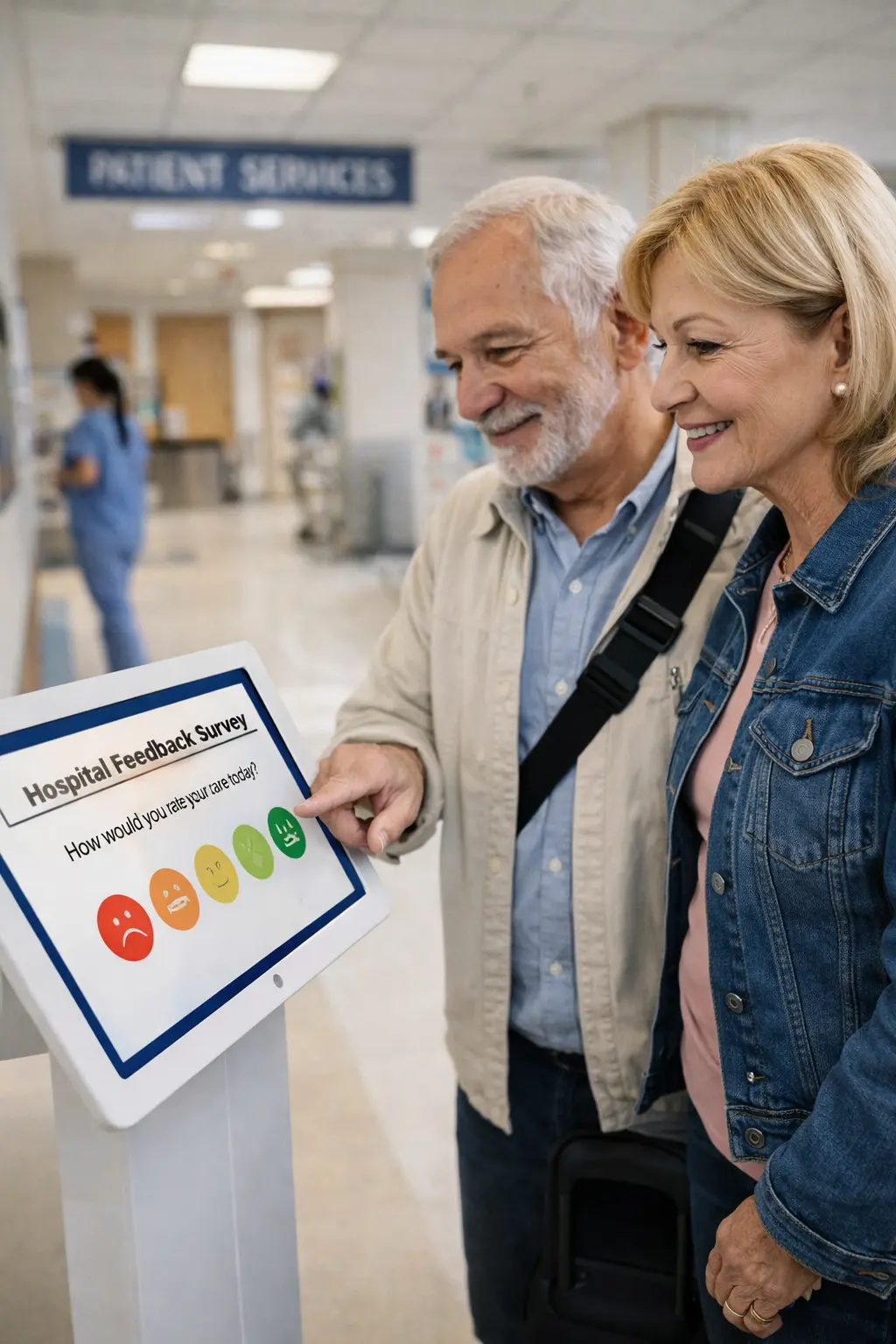
Hospitals have used phone-based feedback collection for years, but the technology behind those calls has changed. Traditional IVR systems were built around keypad inputs, rigid menus, and short, structured flows. Newer Voice AI systems are designed to handle more natural conversations, capture open-ended feedback, and adapt based on what the patient says. Genesys defines IVR as an automated telephone system that interacts through fixed menus and keypad or short spoken responses, while it defines voicebots as AI-powered assistants that understand spoken requests and enable more natural interactions.
For hospitals, this distinction matters because patient surveys are not just about collecting a number. They are often about understanding why the patient gave that rating, whether discharge instructions were clear, whether a complaint should be escalated, and whether the patient wants a callback. At the same time, formal programs such as HCAHPS still require a defined survey instrument and methodology for standardized measurement and public reporting. CMS describes HCAHPS as a national, standardized, publicly reported survey of patients’ perspectives of hospital care.
That creates a practical question for hospital operators: when should you use IVR, and when is Voice AI the better fit?
What is IVR in a hospital survey context?
IVR, or Interactive Voice Response, is the traditional phone-automation model. The patient hears a prompt, then responds by pressing keypad numbers or, in some systems, speaking a short answer. Genesys describes IVR as an automated telephone information system using fixed menus and real-time data, with caller responses coming through key presses or short speech inputs.
In a hospital survey workflow, IVR typically looks like this:
“Press 1 if you were satisfied.”
“Press 2 if you had an issue.”
“Rate your overall experience from 0 to 10.”
This works reasonably well for very short, structured surveys. It is predictable, scalable, and relatively easy to map to fixed reporting fields. That is one reason IVR has remained common in patient feedback and contact-center environments.
What is Voice AI in a hospital survey context?
Voice AI goes beyond fixed menu trees. Instead of asking the patient to navigate a rigid set of options, it can listen to spoken responses, interpret intent, and ask follow-up questions in a more conversational way. Genesys describes voicebots as AI-powered systems that interact through speech, using speech recognition and natural language processing to understand requests and automate responses. It also describes conversational IVR as an AI-driven evolution of traditional IVR that allows callers to interact more naturally using voice.
In a hospital survey workflow, that means a Voice AI agent can ask:
“How has your recovery been since discharge?”
“Were the discharge instructions clear?”
“Overall, how would you rate your experience?”
“Could you tell me what could have been better?”
That makes Voice AI much better suited for capturing context, not just numeric input.
Why the difference matters for hospital surveys
AHRQ’s CAHPS guidance makes clear that patient surveys are about reporting on experiences with care, not just answering generic satisfaction questions. CMS also emphasizes that HCAHPS is a defined instrument and methodology, not just a loose feedback concept.
Operationally, hospitals also need faster, more flexible feedback workflows outside formal benchmark programs. A short phone survey after discharge may need to uncover whether the patient understood medicines, has an unresolved complaint, or needs help from the care team. Those needs are often better served by a conversation than by a keypad tree.
Where IVR still works well
IVR still has a place in hospital feedback systems.
It works best when:
- the survey is very short
- the answer choices are fixed
- the hospital mainly needs structured numeric inputs
- the workflow does not require nuanced follow-up
For example, IVR can be effective for:
- a simple 0–10 rating
- a yes/no question about whether the patient wants a callback
- a quick service-line selection
- a basic post-call feedback prompt after an appointment booking line
In those cases, IVR’s simplicity is an advantage. It is also useful where the organization wants complete consistency in prompts and response paths.
Where IVR starts to break down
The main weakness of IVR is that it is not very good at handling natural feedback. A patient may want to say, “The doctor was excellent, but discharge took too long and I’m still confused about one medicine.” A keypad flow cannot handle that very gracefully.
Traditional IVR also tends to feel impersonal and rigid, especially when the patient has to listen through menus or repeat information. Genesys’ own distinction between fixed-menu IVR and more natural voicebot interactions reflects this limitation.
For hospitals, that rigidity becomes a problem in exactly the situations that matter most:
- post-discharge follow-up
- complaint capture
- multilingual patient outreach
- experience feedback that needs open-ended explanation
- escalation for negative sentiment
Why Voice AI is often better for hospital patient surveys
Voice AI usually works better when the hospital wants both structure and context.
A Voice AI agent can:
- ask the patient for an overall rating
- understand the spoken answer
- ask why the patient gave that score
- detect whether the patient sounds upset or confused
- offer to arrange a callback
- summarize the reason for the hospital team
That is a major operational advantage over traditional IVR because the hospital gets more than a score. It gets the story behind the score.
This aligns well with how modern healthcare experience platforms position AI-driven patient engagement: not just as survey delivery, but as a way to unify self-service, routing, analytics, and action across patient interactions. NiCE positions its healthcare CX platform around AI-powered orchestration, digital self-service, routing, and workflow continuity.
Voice AI is especially strong in post-discharge follow-up
Post-discharge is one of the best examples of where Voice AI beats traditional IVR.
Hospitals often want to ask:
- how the patient is feeling
- whether medicines were understood
- whether follow-up steps are clear
- whether there was a poor experience
- whether someone should call the patient back
AHRQ’s discharge-safety and follow-up resources emphasize post-discharge phone calls as a way to uncover questions, misunderstandings, and discrepancies in the discharge plan.
That kind of workflow is much more naturally handled by Voice AI than by a strict “press 1, press 2” flow.
Voice AI also has an advantage in multilingual settings
Hospitals in India and other multilingual environments often need to speak with patients in English plus one or more regional languages. That makes rigid IVR trees even harder, because menu navigation becomes longer and less intuitive when language selection and branching are added up front.
A conversational Voice AI model can make this easier by allowing the patient to respond naturally in the preferred language, then continuing the flow in that language if supported. That is especially useful for hospitals trying to improve accessibility and response quality across diverse patient populations. This is an implementation inference, but it follows from the broader shift from fixed-menu interaction toward speech-based, AI-assisted interaction described by voicebot platforms.
IVR vs Voice AI: the practical comparison
The simplest comparison looks like this:
IVR is better when the hospital wants:
- fixed options
- very short surveys
- predictable numeric input
- low-complexity routing
Voice AI is better when the hospital wants:
- open-ended feedback
- reasons behind ratings
- post-discharge check-ins
- multilingual conversations
- complaint detection
- escalation workflows
That is why many hospitals will eventually use both: IVR for the most basic structured use cases, and Voice AI for higher-value patient feedback workflows.
Important caveat: Voice AI is not a shortcut for formal HCAHPS compliance
This point is important. Voice AI may be better for conversational operational surveys, but it should not be framed as a replacement for official HCAHPS administration. CMS is explicit that HCAHPS is both a survey instrument and a data-collection methodology, with approved administration rules for valid comparisons and public reporting.
So the right positioning is:
- use formal HCAHPS processes where required
- use Voice AI for operational follow-up, faster feedback capture, and service recovery
That is a more credible and defensible message for HuskyVoiceAI.
How HuskyVoiceAI fits
HuskyVoiceAI is better positioned as a practical Voice AI layer for hospital follow-up and feedback calls.
Hospitals can use HuskyVoiceAI to:
- run short post-discharge feedback calls
- collect ratings and reasons over phone
- capture improvement suggestions
- support multilingual patient outreach
- identify negative sentiment quickly
- trigger human callbacks for complaints or confusion
Compared with traditional IVR, that gives the hospital richer feedback and a more human patient experience, especially in care journeys where context matters.
Final takeaway
IVR and Voice AI are not the same thing, and they are not equally suited to every hospital survey workflow.
Traditional IVR is still useful for simple, structured, menu-driven feedback collection. Genesys defines it as an automated system built around fixed menus and keypad or short spoken responses.
Voice AI is better when the hospital wants natural language, context, follow-up questions, and more patient-friendly feedback collection. Voicebot platforms explicitly position this as a more conversational alternative to basic IVR.
For HuskyVoiceAI, the strongest angle is clear: help hospitals move beyond rigid IVR flows for post-discharge, multilingual, and service-recovery survey calls while respecting the fact that formal benchmark programs like HCAHPS still have their own methodology and reporting requirements.
FAQ
What is the difference between IVR and Voice AI in hospitals?
IVR uses fixed menus and keypad or limited voice responses, while Voice AI is designed for more natural speech-based conversations and follow-up questions.
Is Voice AI better than IVR for patient surveys?
Usually yes for open-ended, multilingual, or post-discharge surveys. IVR still works well for very short, structured questions.
Can Voice AI replace HCAHPS?
No. HCAHPS is a formal CMS-standardized survey and methodology for hospital patient experience reporting. Voice AI is better positioned as an operational complement.
When should a hospital still use IVR?
IVR is still useful when the survey is short, the answer choices are fixed, and the hospital mainly needs numeric or yes/no input.