
For decades, the global B2B playbook has been written in Silicon Valley. It’s a story where emails initiate deals, calendars provide structure, and CRMs serve as the ultimate source of truth. In markets like the U.S., where asynchronous communication and “paper trails” are cultural norms, this works. But when you apply this framework to India—the world’s fastest-growing major economy—the system doesn’t just lag; it breaks.
In India, deals don’t live in the inbox. They live in the earpiece. This isn’t a lack of digital maturity; it is a structural reality. In the Bharat-market context, your phone is the CRM.
This isn’t a behavioral quirk. It’s a structural reality of how business works in India.
And it leads to a simple but uncomfortable conclusion:
In India, your phone is the CRM.
The “Assumptive Gap” in Global Sales Software
Most traditional CRMs (like Salesforce or HubSpot) were designed with Western business etiquette in mind. They assume that:
- Documentation precedes action: If it isn’t in the CRM, it didn’t happen.
- Language is uniform: Business is conducted in formal English.
- Decision-making is linear: A lead moves from MQL to SQL via scheduled Zoom calls.
According to research on High-Context vs. Low-Context cultures, India is a high-context society. Trust isn’t built through a well-formatted PDF; it’s built through the cadence of a voice, the speed of a WhatsApp reply, and the ability to “code-switch” between languages instantly.
The Uncomfortable Truth About CRMs in India
Ask any Indian founder, sales leader, or business owner how deals actually close, and you’ll hear the same pattern:
- The most important conversations happen on calls
- Key objections are handled verbally
- Trust is built through tone, not text
- WhatsApp is where follow-ups really happen
- Email shows up after intent is clear
Yet most CRMs are designed as if none of this exists.
They assume:
- Emails are the primary source of truth
- Meetings are scheduled, not spontaneous
- Conversations are documented, not lived
- Language is uniform
- Decisions are slow and structured
That assumption gap is why CRMs often feel “heavy” or “unused” in India — not because teams are undisciplined, but because the tools don’t reflect reality.
Why Voice Scales Trust (Where Text Fails)
In a market characterized by high competition and fragmented trust, voice serves as a “Proof of Seriousness.”
- Emotional Signaling: A 2-minute call conveys urgency, empathy, and intent that 20 emails cannot.
- The Language Advantage: India’s internet users are increasingly non-English speaking. Google’s “Year in Search” India reports consistently show a massive surge in regional language queries. Voice allows sales reps to pivot between Hindi, Tamil, or “Hinglish” to make a buyer feel at home.
- The “Let’s Talk Once” Factor: In India, this phrase is the ultimate signal of a high-intent buyer. If your sales tool can’t capture that call, you’ve lost the most important data point of the quarter.
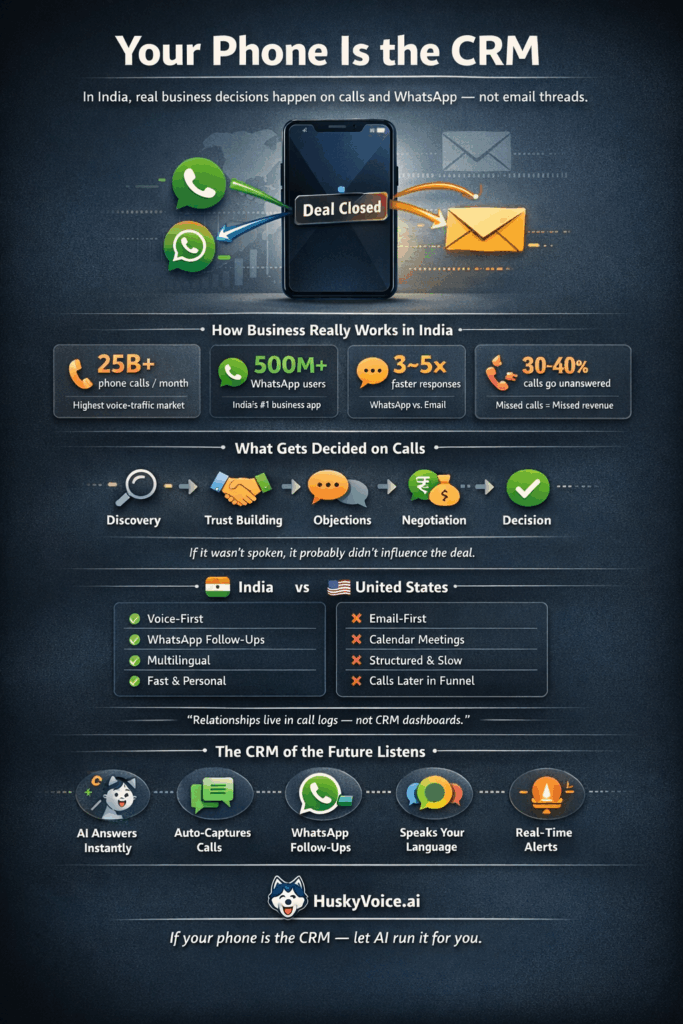
How Deals Actually Move in India
To understand why the phone becomes the CRM, you need to look at how deals actually progress.
A typical India B2B motion looks like this:
- Inbound call or missed call
- Quick callback within minutes
- Real conversation to understand context
- Negotiation happens live
- WhatsApp message with price / confirmation
- Email sent for record-keeping
The critical steps — discovery, trust, negotiation, decision — all happen before the CRM even wakes up.
If a business misses step 1 or 2, the deal often disappears. Not next quarter. Not next month. Immediately.
That’s why missed calls in India don’t mean “follow up later.”
They mean “lost opportunity.”
Why Voice Builds Trust Faster Than Text
India is a high-context, relationship-driven market.
People don’t just evaluate what you say — they evaluate how you say it:
- Tone
- Confidence
- Empathy
- Language choice
- Willingness to respond quickly
Voice carries all of that. Email carries none of it.
A 2-minute call can:
- Replace a 10-email thread
- Clarify objections instantly
- Create emotional reassurance
- Signal seriousness and intent
This is why buyers often say things like:
“Let’s talk once.”
That single call is often the real decision point.
WhatsApp: The Invisible Layer of the Tech Stack
In India, WhatsApp isn’t just a messaging app; it’s business infrastructure. With over 500 million users in India, it has replaced the inbox for:
- Real-time follow-ups.
- Payment reminders.
- Sharing “unfiltered” feedback.
The uncomfortable truth: If your CRM doesn’t “see” WhatsApp and Voice, it is blind to 80% of your sales activity. This leads to the “Dark Social” problem of B2B—where your best data stays locked in your reps’ private chat histories.
Email’s Real Role in India (And Why That’s OK)
Email isn’t irrelevant in India — it’s just misunderstood.
Email is used for:
- Quotations
- Agreements
- Documentation
- Audit trails
But rarely for persuasion or decision-making.
That doesn’t mean Indian buyers are unsophisticated.
It means they value speed, clarity, and human connection over structure.
Trying to force email-first workflows into this environment slows everything down.
India vs the United States: Two Different GTM Realities
The contrast becomes clear when you compare deal motion across markets.
In the United States:
- Email initiates most B2B conversations
- Calendar links structure engagement
- Zoom / Google Meet calls happen later
- CRMs capture most meaningful interactions
- Decisions tolerate longer cycles
In India:
- Phone calls initiate trust
- WhatsApp accelerates follow-ups
- Conversations happen immediately
- CRMs see only the aftermath
- Speed beats structure
Neither model is “better.”
They are simply built on different assumptions.
The mistake is using one market’s playbook in another without adapting.
Language Changes Everything
Another reason phones dominate in India is language.
While many Indian professionals understand English, decision-making is easier in familiar languages:
- Hindi
- Hinglish
- Tamil
- Telugu
- Kannada
- Marathi
- Gujarati
- Bengali
Voice allows natural code-switching:
- English for technical terms
- Local language for reassurance
- Hinglish for speed and comfort
Email struggles here. Voice thrives.
The Cost of Missed Calls (It’s Higher Than You Think)
In many Indian businesses:
- 30–40% of inbound calls go unanswered
- Peak hours overwhelm small teams
- Calls arrive outside business hours
- Follow-ups get delayed or forgotten
Each missed call is:
- A lost lead
- Lost context
- Lost momentum
- Lost trust
CRMs don’t register missed calls as lost revenue.
But operators feel it every day.
Why Traditional CRMs Miss the Real Story
Even when calls are logged, CRMs usually capture:
- A timestamp
- A duration
- A short note
They miss:
- Tone
- Urgency
- Objections
- Language used
- Emotional signals
That’s like summarizing a negotiation by saying:
“Meeting happened.”
Technically true. Practically useless.
The Myth of “Better Data Entry”
Many CRM conversations end with:
“If only reps logged data properly.”
But this misses the point.
The problem isn’t discipline.
The problem is design.
Asking teams to manually reconstruct fast, emotional, multilingual conversations after the fact is unrealistic — especially in high-velocity markets like India.
The CRM needs to adapt to reality, not the other way around.
What a Voice-Native CRM Actually Looks Like
If the phone is the CRM, then the CRM should:
- Answer calls instantly
- Capture conversations automatically
- Understand intent and urgency
- Work across languages
- Trigger actions in real time
- Follow up via WhatsApp without delay
In other words, it should listen, not just store.
This is why voice-native systems and AI voice agents are emerging — not as replacements for CRMs, but as the missing front layer.
Why India Is Leading the Voice-First Shift
Interestingly, India isn’t behind the curve here.
It’s ahead.
Markets where:
- Voice volume is high
- Language diversity is real
- Speed matters more than structure
…are forcing software to evolve faster.
What works in India today will increasingly matter in:
- Southeast Asia
- Middle East
- Africa
- Latin America
India isn’t an edge case.
It’s a preview.
The Future: From “Systems of Record” to “Systems of Conversation”
CRMs were built as systems of record.
The next generation will be systems of conversation:
- Listening first
- Acting in real time
- Capturing context automatically
- Supporting human workflows, not replacing them
Voice AI isn’t about removing people from the process.
It’s about making sure no conversation — and no opportunity — is lost.
A Founder’s Realization
When we started our go-to-market in India, this realization didn’t come from theory.
It came from friction.
Email-led workflows felt slow.
CRM updates felt incomplete.
But calls and WhatsApp moved everything forward.
Once we accepted that reality, everything else made sense.
The Takeaway
If you’re building for India, don’t ask:
“How do we get people to use the CRM more?”
Ask:
“How do we make the CRM understand the phone?”
Because in India:
- Conversations close deals
- Speed builds trust
- Voice carries intent
- WhatsApp carries momentum
And ultimately:
Your phone is the CRM.
If you are building or selling in India, stop fighting the culture. Don’t ask, “How do I get my reps to log their calls?” Instead, ask: “How do I make my CRM understand the phone?” In a market where speed is the only moat and voice is the only currency, your phone isn’t just a device—it’s your most valuable database.
Author’s Note
This perspective is based on real GTM experience building for both U.S. and India markets. If you’re designing products, sales motions, or customer workflows for India (or similar voice-first markets), this distinction isn’t optional — it’s foundational.