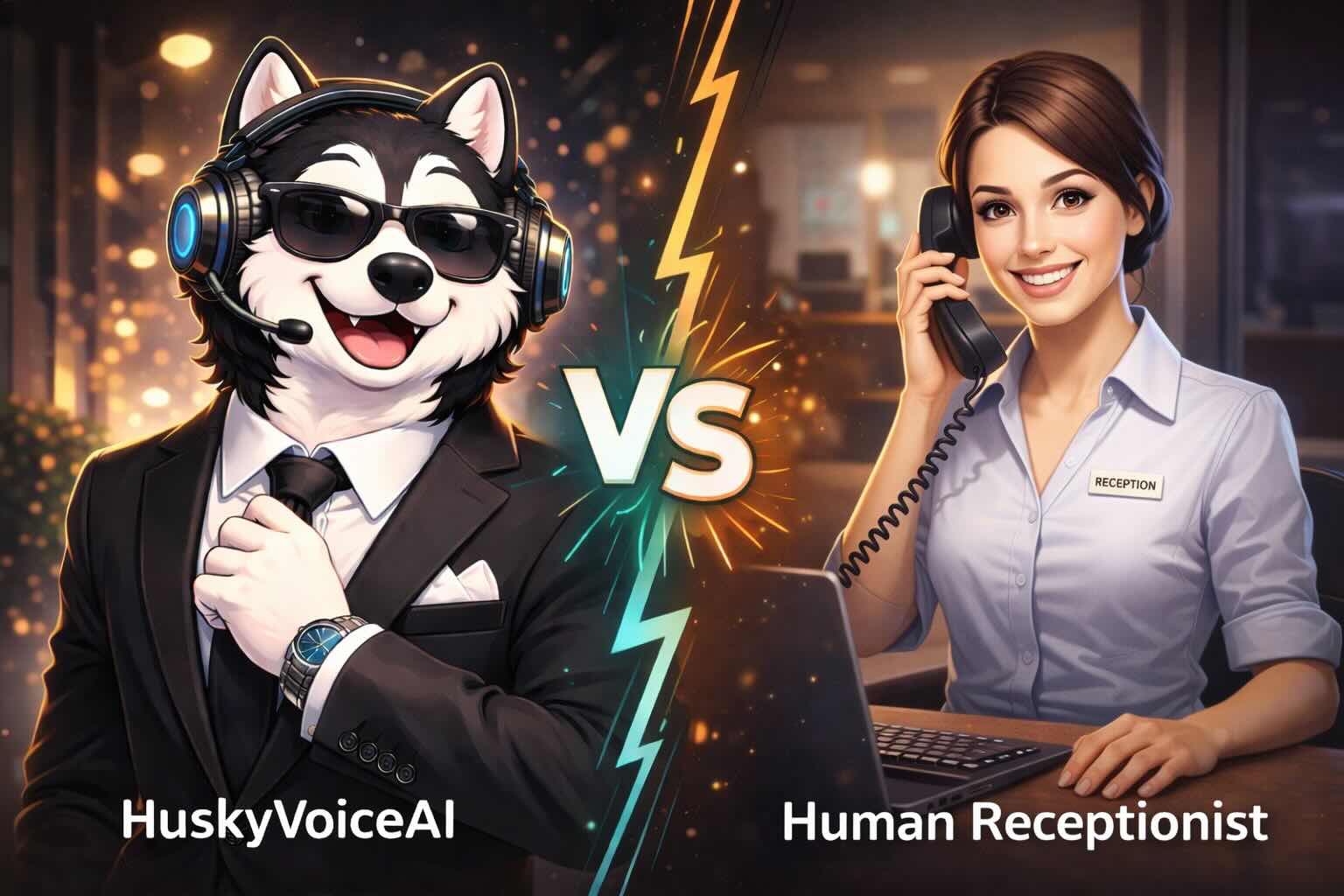
At first glance, AI receptionist and virtual receptionist sound like the same thing. Many businesses even use the terms interchangeably.
But in practice, they refer to two very different ways of handling business calls — with different costs, capabilities, and outcomes.
If you’re trying to decide between the two, the difference comes down to who (or what) is actually answering your calls.
What is a virtual receptionist?
A virtual receptionist is a real human who answers calls remotely, usually through a third-party service. They follow predefined scripts, take messages, and transfer calls when required.
Virtual receptionists are commonly used for:
- Small teams without a front desk
- After-hours coverage
- Basic call screening
From the caller’s perspective, they’re speaking to a real person — just not someone physically present in your office.
What is an AI receptionist?
An AI receptionist answers calls using conversational AI instead of a human agent.
It can:
- Understand what callers say in natural language
- Ask follow-up questions
- Book appointments
- Route calls or capture details
- Operate 24/7 without shifts or handoffs
The interaction feels conversational, but it’s handled entirely by software.
The core difference: people vs systems
The simplest way to think about it:
- Virtual receptionist → a human working remotely
- AI receptionist → a system designed to handle calls automatically
That difference affects everything else — from cost and availability to consistency and scalability.
Availability and reliability
Virtual receptionists
- Work scheduled hours
- May be unavailable during peak times
- Quality depends on individual agents
AI receptionists
- Always available, including nights and weekends
- No wait times
- Same experience for every caller
For businesses that receive calls outside standard hours, this can be a deciding factor.
Handling appointments and actions
This is where the gap becomes clear.
- Virtual receptionists typically take messages or relay information
- AI receptionists can complete tasks during the call
That includes:
- Booking appointments in real time
- Confirming availability
- Triggering follow-ups automatically
The result is fewer handoffs and faster outcomes.
Cost structure and scalability
Virtual receptionist services usually charge:
- Per minute
- Per call
- Or per agent
As call volume grows, costs rise accordingly.
AI receptionists typically follow:
- Predictable pricing models
- No per-agent scaling costs
For growing businesses, this difference becomes noticeable over time.
Consistency and training
Human receptionists require:
- Training
- Ongoing supervision
- Script updates
AI receptionists:
- Follow defined logic consistently
- Don’t forget instructions
- Don’t vary by shift or experience
This matters for businesses that want a uniform caller experience.
When a virtual receptionist makes sense
A virtual receptionist may be the right fit when:
- Call volume is low
- Calls are highly nuanced or emotional
- The business prefers human-only interactions
In some cases, personal touch outweighs speed or automation.
When an AI receptionist is a better fit
Businesses often choose an AI receptionist when:
- Calls are frequent or unpredictable
- Appointments and enquiries drive revenue
- After-hours calls matter
- Operational costs need to stay predictable
For these teams, automation isn’t about removing people — it’s about keeping up with demand.
A hybrid approach many teams take
Some businesses combine both:
- AI receptionist for routine inbound calls
- Human support for edge cases or escalations
This balances efficiency with flexibility.
Final takeaway
A virtual receptionist gives you human coverage.
An AI receptionist gives you system-level reliability and scale.
The right choice depends on how important availability, consistency, and cost predictability are to your business.
Learn more
To understand how modern businesses handle calls automatically while keeping the experience natural, explore how an AI receptionist for businesses works here:
👉 https://www.huskyvoice.ai/ai-receptionist