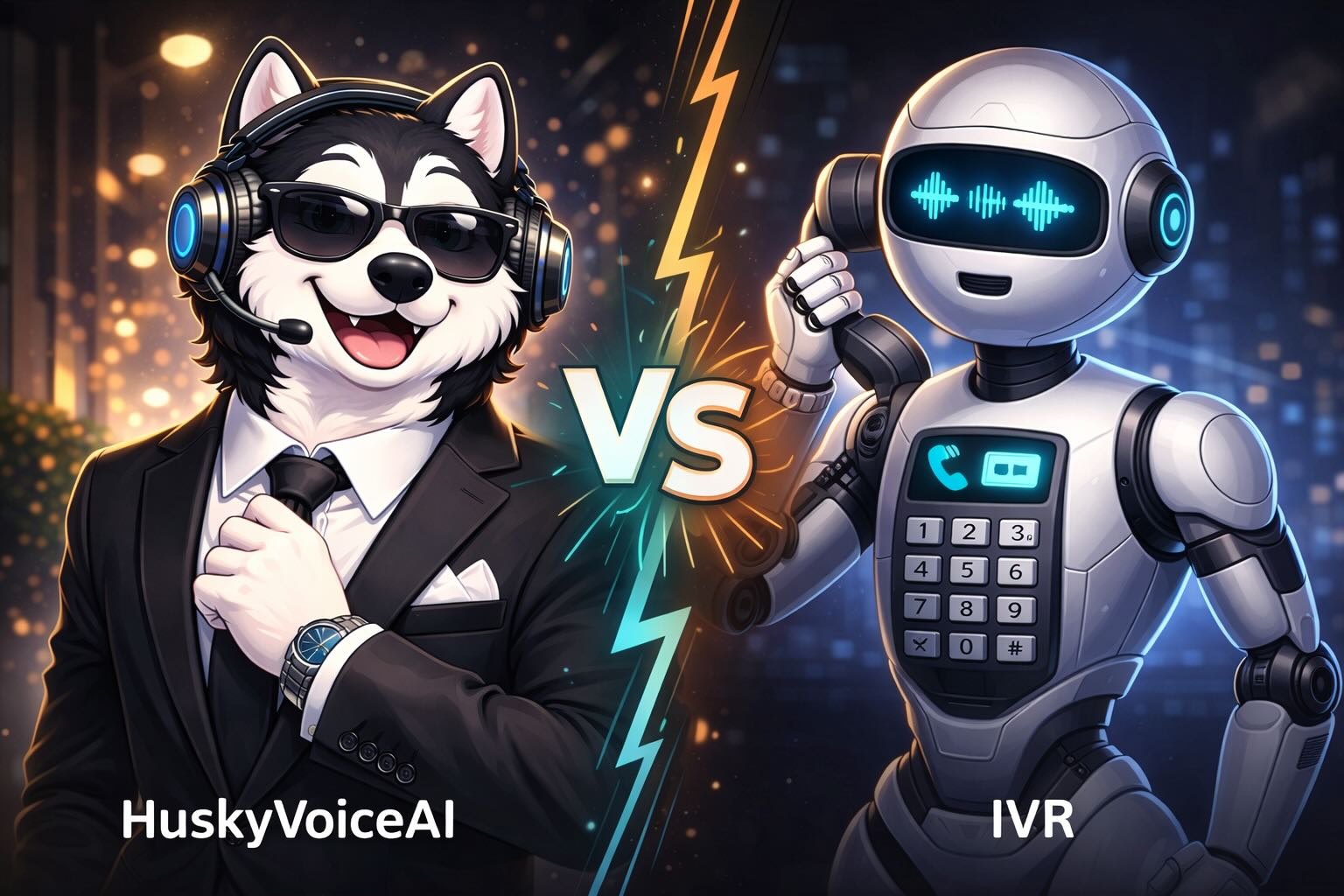
If your business still relies on an IVR (“Press 1 for sales, Press 2 for support”), you’re not alone. IVRs have been the default call-handling system for decades.
But many teams are now asking a practical question:
Should we keep IVR, or move to an AI receptionist?
The answer isn’t about trends or buzzwords. It comes down to how customers actually behave on calls — and what your business needs from those conversations.
What is an IVR?
An IVR (Interactive Voice Response) system routes callers using fixed menus and keypad inputs.
A typical IVR flow looks like this:
- “Press 1 for sales”
- “Press 2 for support”
- “Press 3 for billing”
IVRs are predictable, rule-based, and relatively easy to set up. They work best when:
- Call volumes are low
- Requests are simple
- Callers already know what they want
However, IVRs haven’t changed much in how they interact with humans.
What is an AI receptionist?
An AI receptionist answers calls like a real front-desk assistant would.
Instead of forcing callers through menus, it:
- Listens to what the caller says
- Understands intent in natural language
- Asks clarifying questions when needed
- Takes actions such as booking appointments, routing calls, or capturing details
From the caller’s perspective, it feels closer to speaking with a human than navigating a phone tree.
The core difference: menus vs conversations
The biggest difference between IVR and an AI receptionist isn’t technology — it’s interaction style.
IVR
- Forces callers to adapt to the system
- Assumes callers know the right option
- Breaks down when requests don’t fit neatly into menus
AI receptionist
- Adapts to how callers speak
- Handles open-ended requests
- Works even when callers are unsure or vague
This difference alone explains why many businesses see higher call completion rates with conversational systems.
Customer experience: where IVRs fall short
IVRs are efficient on paper, but frustrating in practice.
Common issues businesses see:
- Callers pressing the wrong option
- Repeating information multiple times
- Dropping off before reaching the right team
- Hanging up during long menus
An AI receptionist reduces friction by keeping the conversation moving naturally — especially for first-time callers who don’t know your internal structure.
Handling real-world scenarios
Let’s look at how each system performs in everyday situations.
Appointment booking
- IVR: Requires rigid menu flows and manual confirmation
- AI receptionist: Collects details, checks availability, confirms bookings in one conversation
After-hours calls
- IVR: Often ends in voicemail
- AI receptionist: Continues answering, capturing intent, and scheduling follow-ups
Mixed or unclear requests
- IVR: Fails unless the caller guesses correctly
- AI receptionist: Asks follow-up questions to clarify intent
Setup and flexibility
IVRs are simple to deploy but rigid to change. Every update requires re-recording prompts and redesigning menus.
AI receptionists are more flexible:
- Call flows can evolve without re-recording scripts
- New use cases can be added without redesigning menus
- Language and phrasing can adapt to different callers
This matters for businesses whose call patterns change over time.
Cost considerations
IVRs are typically cheaper upfront. That’s why they’re still widely used.
However, the hidden cost shows up elsewhere:
- Missed calls
- Abandoned calls
- Lost leads
- Manual follow-ups by staff
AI receptionists cost more than basic IVRs, but they often replace:
- Additional reception staff
- Call overflow services
- After-hours answering services
The real comparison is not IVR vs AI — it’s missed opportunities vs captured conversations.
When IVR still makes sense
IVR is not obsolete. It still works well when:
- Calls are short and transactional
- Callers are repeat customers
- The goal is basic routing, not engagement
For some internal or support-heavy environments, IVR may be sufficient.
When an AI receptionist is the better choice
Businesses typically move beyond IVR when:
- Calls drive revenue or bookings
- First-time callers matter
- Missed calls have real cost
- Conversations are unpredictable
- Customer experience is a priority
Service-based businesses, appointment-driven teams, and growing SMBs often fall into this category.
A practical middle ground
Many companies don’t switch overnight.
A common approach is:
- Keep IVR for internal routing or legacy flows
- Use an AI receptionist for inbound customer calls, bookings, and enquiries
This reduces risk while improving customer-facing interactions.
Final takeaway
IVRs are built for control.
AI receptionists are built for conversation.
If your business depends on phone calls to capture leads, book appointments, or support customers, the difference between menus and conversations is no longer small — it’s measurable.
Learn more
If you want to understand how modern AI receptionists work in real business settings, you can explore examples of AI call answering and conversational reception systems here:
👉 https://www.huskyvoice.ai/ai-receptionist