A customer calls your business.
Who should answer?
A person?
An AI receptionist?
Or should both work together?
That is the real decision many businesses are facing now.
The comparison is often framed too simply:
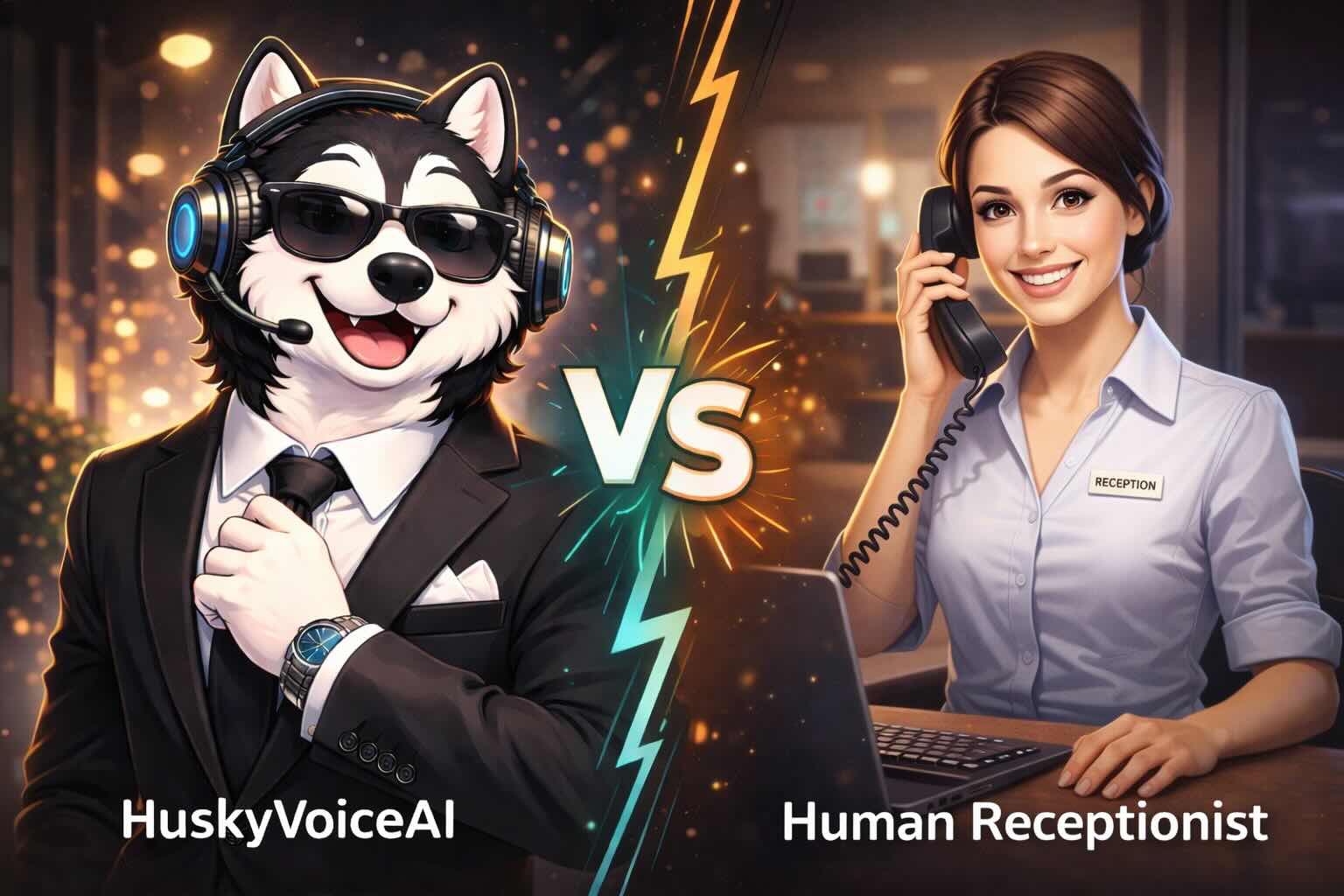
AI receptionist vs human receptionist
as though one must completely replace the other.
In practice, the better question is:
Which types of calls are best handled by AI, and which ones still benefit from a person?
That distinction matters because the two are good at different things.
Human receptionists bring:
- judgment
- empathy
- flexibility
- relationship awareness
AI receptionists bring:
- 24/7 availability
- simultaneous call handling
- consistency
- structured automation
- scalable capacity
For many businesses, the strongest operating model is not choosing one.
It is combining them.
Quick Comparison: AI Receptionist vs Human Receptionist
| Area | AI Receptionist | Human Receptionist |
|---|---|---|
| 24/7 availability | Strong | Requires shifts |
| Multiple simultaneous calls | Strong | Limited by staffing |
| Repetitive FAQs | Strong | Good, but time-consuming |
| Appointment booking | Strong when integrated | Strong |
| Complex exceptions | Limited | Strong |
| Emotional conversations | Limited | Strong |
| Consistency | Very high | Varies |
| Scaling during call spikes | Easier | Requires staffing |
| Technical judgment | Should escalate | Better with training |
| Relationship building | Limited | Strong |
| Structured data capture | Strong | Usually manual |
| Cost model | Usage/software based | Salary + benefits + management |
The key is not which column has more strengths.
It is which strengths your business actually needs.
What Does a Human Receptionist Do Well?
Human receptionists are valuable because conversations are not always predictable.
A caller may say:
“I know this is unusual, but let me explain what happened.”
A good receptionist can:
- listen
- understand nuance
- ask unexpected follow-up questions
- interpret tone
- adjust the conversation
- make judgment calls
- reassure the customer
That flexibility is difficult to reduce to a fixed workflow.
Humans Are Strong at Exceptions
Most routine business calls are relatively predictable.
But exceptions are where human capability becomes important.
Examples include:
- complicated billing issue
- upset customer
- unusual service request
- repeat service failure
- special accommodation
- complex commercial inquiry
- pricing negotiation
These situations may not fit neatly into standard automation.
Humans Are Better at Relationship-Sensitive Conversations
Some callers do not simply need information.
They need someone to understand how they feel.
Consider:
“This is the third time I’ve called and I’m really frustrated.”
A skilled employee may recognize:
- frustration
- previous history
- urgency
- relationship risk
They may know when to:
- apologize
- escalate
- involve a manager
- make an exception
That is difficult to automate safely.
Where Human Receptionists Struggle
The limitations are not about competence.
They are structural.
One Person Can Usually Handle One Call at a Time
If your receptionist is already speaking with someone, the next caller must:
- wait
- reach voicemail
- route elsewhere
That creates a capacity problem.
Humans Need Working Hours
A normal front desk might operate:
9 AM–5 PM.
Customers may call:
- at 7 PM
- on weekends
- early morning
- during holidays
Covering all of those hours requires:
- additional employees
- shifts
- overtime
- answering services
Repetitive Work Consumes Human Attention
A receptionist may answer the same questions repeatedly:
“What are your hours?”
“Do you have anything tomorrow?”
“Can I reschedule?”
“Do you serve my ZIP code?”
These calls need to be handled.
But they may not require much human judgment.
What Does an AI Receptionist Do Well?
AI receptionists are strongest when the conversation follows a predictable business process.
For example:
Customer calls
↓
Intent understood
↓
Relevant information collected
↓
Approved next action
That next action might be:
- answer FAQ
- schedule
- qualify
- route
- create callback
- capture service request
AI Can Answer 24/7
This is one of the clearest differences.
An AI receptionist does not need:
- lunch
- weekends
- shifts
- overnight staffing
That makes it useful for businesses receiving meaningful calls outside normal hours.
For example:
A customer calls at 8:30 PM:
“I’d like to schedule an appointment.”
If scheduling is connected, AI may be able to complete the booking immediately.
Without after-hours coverage, that call may otherwise become voicemail.
AI Can Handle Several Calls at Once
This is another structural advantage.
Suppose five customers call simultaneously.
One human receptionist cannot have five separate conversations.
An AI system can potentially handle several concurrent calls, depending on the platform configuration.
This is valuable for:
- seasonal peaks
- marketing campaigns
- lunch hours
- Monday mornings
- weather-related spikes
Businesses can add peak capacity without permanently increasing staffing.
AI Is Strong at Repetitive Workflows
Examples include:
- scheduling
- rescheduling
- standard FAQs
- new-customer intake
- basic qualification
- reminders
- missed-call callbacks
These processes tend to follow clear rules.
That is where automation performs best.
AI Can Capture Structured Information Automatically
A human receptionist may write:
“Customer wants AC repair tomorrow.”
An AI workflow can potentially produce:
Customer: Existing
Intent: AC repair
Location: Confirmed
Reported issue: System running but not cooling
Preferred time: Tomorrow morning
Appointment: Booked
That information can then move into:
- CRM
- scheduling
- dispatch
- other workflows
This can reduce manual data entry.
Where AI Receptionists Struggle
AI has limitations too.
These should be considered seriously.
Complex or Unusual Conversations
A customer may describe something the workflow has never encountered.
The AI should not guess.
It should recognize uncertainty and escalate.
Emotional Situations
Consider:
“Your technician damaged my property and nobody has called me back.”
This is not simply:
service request → booking.
It may require:
- empathy
- accountability
- manager involvement
- resolution authority
A human is usually better positioned to handle it.
Negotiation
If a customer says:
“Your competitor quoted $1,000 less. Can you match it?”
the AI should not invent a discount.
Pricing exceptions and negotiation normally belong to employees with authority.
Technical Diagnosis
In businesses such as:
- HVAC
- healthcare
- legal services
- financial services
there are conversations where professional judgment matters.
AI can:
capture → route
but should not pretend to replace qualified expertise.
Human Receptionist Cost vs AI Receptionist Cost
This is one reason businesses compare the two.
But cost comparisons need to be fair.
A human receptionist may involve:
- salary
- payroll taxes
- benefits
- training
- equipment
- management
- leave coverage
- recruiting costs
An AI receptionist typically involves:
- monthly subscription
- usage fees
- phone-number charges
- integrations
- setup
- possible overage
However, comparing:
human salary
against:
AI software price
can be misleading.
They are not identical resources.
The better question is:
Which tasks are we paying people to perform that could be handled reliably by automation?
Example: Small Dental Practice
Suppose a dental practice has one receptionist.
During the day they handle:
- patient check-in
- billing
- appointment changes
- calls
The phone rings while they are helping a patient.
Human-only model
Second caller waits or reaches voicemail.
AI-only model
AI handles all calls.
But complex patient questions may require human escalation.
Hybrid model
Human handles the front desk.
AI handles:
- overflow
- after-hours
- routine booking
- basic FAQs
Complex calls go to the receptionist.
This may be more practical than either extreme.
Example: HVAC Company
An HVAC company receives heavy call spikes during hot weather.
Human-only
More office staff may be needed during peak season.
AI-only
AI could handle routine service intake, but complex repeat-service complaints or unusual commercial requests may need people.
Hybrid
AI handles:
- overflow
- after-hours
- standard repair intake
- maintenance booking
Humans handle:
- upset customers
- complex commercial calls
- unusual warranty issues
This matches capability to call type.
Example: B2B Sales Team
A prospect calls:
“Can your platform handle 5,000 calls a month?”
AI can:
- answer approved product questions
- qualify
- capture company
- book demo
Another caller says:
“We’re evaluating several vendors and need to negotiate enterprise pricing.”
That should likely move to sales.
Again:
structured work → AI
judgment-heavy work → human
AI vs Human for Appointment Booking
Routine appointment booking is one area where AI can be particularly effective.
If integrated with scheduling, AI can:
- check availability
- offer times
- create bookings
- reschedule
- send confirmation
Humans remain useful when:
- scheduling is complicated
- customer requires exception
- specific employee needs coordination
- no suitable availability exists
AI vs Human for After-Hours Calls
This comparison is fairly straightforward.
Human model
Requires:
- shifts
- answering service
- on-call staff
AI model
Can provide continuous first-response coverage.
But after-hours AI still needs clear rules for:
- urgent calls
- complaints
- escalation
- unsupported questions
AI solves availability.
It does not eliminate the need for human escalation.
AI vs Human for High Call Volume
Suppose your office usually gets one active call at a time.
Then a campaign launches.
Suddenly six calls arrive.
Humans scale through staffing.
AI scales through concurrent sessions.
This makes AI particularly attractive for businesses with variable demand.
If call volume is consistently high all day and conversations are complex, additional employees may still make sense.
AI vs Human for Lead Qualification
AI can be useful when qualification follows clear questions.
For example:
- company
- industry
- requirement
- location
- timeline
- approximate scale
The AI can capture these consistently.
But if the lead needs:
- consultation
- negotiation
- strategic discussion
- complex product evaluation
a salesperson should take over.
The ideal workflow can be:
AI qualifies → salesperson consults
rather than:
salesperson spends time collecting every basic field.
AI vs Human for Customer Complaints
This is where humans generally have an advantage.
AI may recognize:
complaint / escalation
and collect context.
But customers experiencing frustration often want someone with:
- empathy
- authority
- accountability
A sensible workflow is:
AI detects complaint
↓
collects basics
↓
human takes over
The AI’s job is getting the caller to the right person quickly.
AI vs Human for Multilingual Calls
This is an interesting category.
Hiring staff fluent in every language your customers use can be difficult.
Voice AI can potentially provide multilingual coverage more flexibly.
This can help with:
- routine intake
- scheduling
- FAQs
But language support should be tested carefully.
Complex emotional or culturally nuanced conversations may still benefit from fluent human staff.
Which Model Should a Small Business Choose?
There are four common options.
Option 1: Human-Only
Good fit when:
- call volume is modest
- almost every conversation requires judgment
- customers expect high-touch service
- after-hours coverage is not important
Option 2: AI-Only
Potential fit when:
- most calls follow structured workflows
- high concurrency matters
- 24/7 coverage matters
- human involvement is rarely necessary
Even then, a human escalation path is still wise.
Option 3: Human-First + AI Overflow
This is often an attractive small-business model.
Human available
→ human answers
Human busy
→ AI answers
After hours
→ AI answers
This preserves the existing experience while increasing capacity.
Option 4: AI-First + Human Escalation
The AI handles initial calls.
Routine requests are completed automatically.
Complex situations move to employees.
This can work well when businesses receive many repetitive calls.
Start by Dividing Your Calls Into Two Buckets
Review your recent phone activity.
Create:
Bucket A — predictable
Examples:
- business hours
- appointment booking
- rescheduling
- service intake
- lead qualification
- routine FAQ
Bucket B — judgment-heavy
Examples:
- complaint
- negotiation
- sensitive issue
- complicated account
- unusual service situation
Then ask:
Why should Bucket A consume the same human capacity as Bucket B?
That question often reveals where AI can add value.
A Better Model: AI Handles Repetition, Humans Handle Judgment
This is probably the simplest framework.
AI
Good at:
- repeatability
- availability
- concurrency
- consistent intake
- structured workflows
Humans
Good at:
- judgment
- empathy
- flexibility
- exceptions
- relationships
The business should design the phone workflow around those strengths.
Do Customers Care Whether the Receptionist Is AI?
Some will.
Some will not.
What customers usually care about more is whether:
- someone answers
- they are understood
- information is accurate
- their request gets completed
- they can reach a person when needed
An AI system should also be transparent that it is an AI assistant rather than pretending to be a human employee.
Trust is more important than imitation.
Do Not Measure Success by Automation Rate
Imagine:
Company A
Automates 95% of calls.
But customers frequently complain.
Company B
Automates 65%.
The remaining 35% go to people.
Customers get fast answers and complex issues are handled properly.
Company B may have the better system.
The objective is not:
maximum AI.
It is:
appropriate AI.
Metrics to Compare
Whether you use AI, humans, or both, track:
- answer rate
- missed calls
- hold time
- appointments booked
- lead conversion
- human escalations
- after-hours outcomes
- customer complaints
- call abandonment
- front-desk workload
- callback volume
- cost per useful outcome
This gives you an operational comparison rather than a theoretical one.
Where HuskyVoiceAI Fits
HuskyVoiceAI can be configured in different operating models depending on how much automation the business wants.
For example:
Human-first
Incoming call
↓
Human available?
Yes → human
No → Voice AI
AI-first
Voice AI answers
↓
Intent identified
↓
Routine → AI completes workflow
Complex → human handoff
After-hours
Business hours → human team
After hours → Voice AI
The Voice AI layer can support workflows such as:
- answering
- appointment booking
- lead qualification
- service intake
- reminders
- follow-up calls
- missed-call recovery
- human escalation
- structured call summaries
The purpose is not necessarily to replace receptionists.
It is to automate the parts of the phone workload where software adds the most leverage.
A 10-Question Decision Checklist
Ask these before deciding between AI and another receptionist.
- How many calls do we miss?
- How many arrive after hours?
- How often do several callers arrive simultaneously?
- What percentage of calls are repetitive?
- How much time does staff spend booking and rescheduling?
- Which calls genuinely require judgment?
- Do we need multilingual coverage?
- Do we need outbound reminders or callbacks?
- Can our scheduling or CRM systems integrate with Voice AI?
- What does each model cost per useful outcome?
The answers will usually make the right operating model much clearer.
The Bottom Line
AI receptionists and human receptionists are not interchangeable.
They have different strengths.
Humans are strong at:
- empathy
- judgment
- exceptions
- relationships
- complex conversations
AI is strong at:
- 24/7 coverage
- simultaneous calls
- repetitive workflows
- consistent information capture
- scheduling
- structured automation
So the best answer for many businesses is not:
AI receptionist or human receptionist?
It is:
Which calls should AI handle, and which calls deserve a person?
Let AI take care of the predictable work.
Let people focus on the moments where judgment, empathy, and expertise matter.
That is often a stronger business model than forcing either humans or AI to do everything.