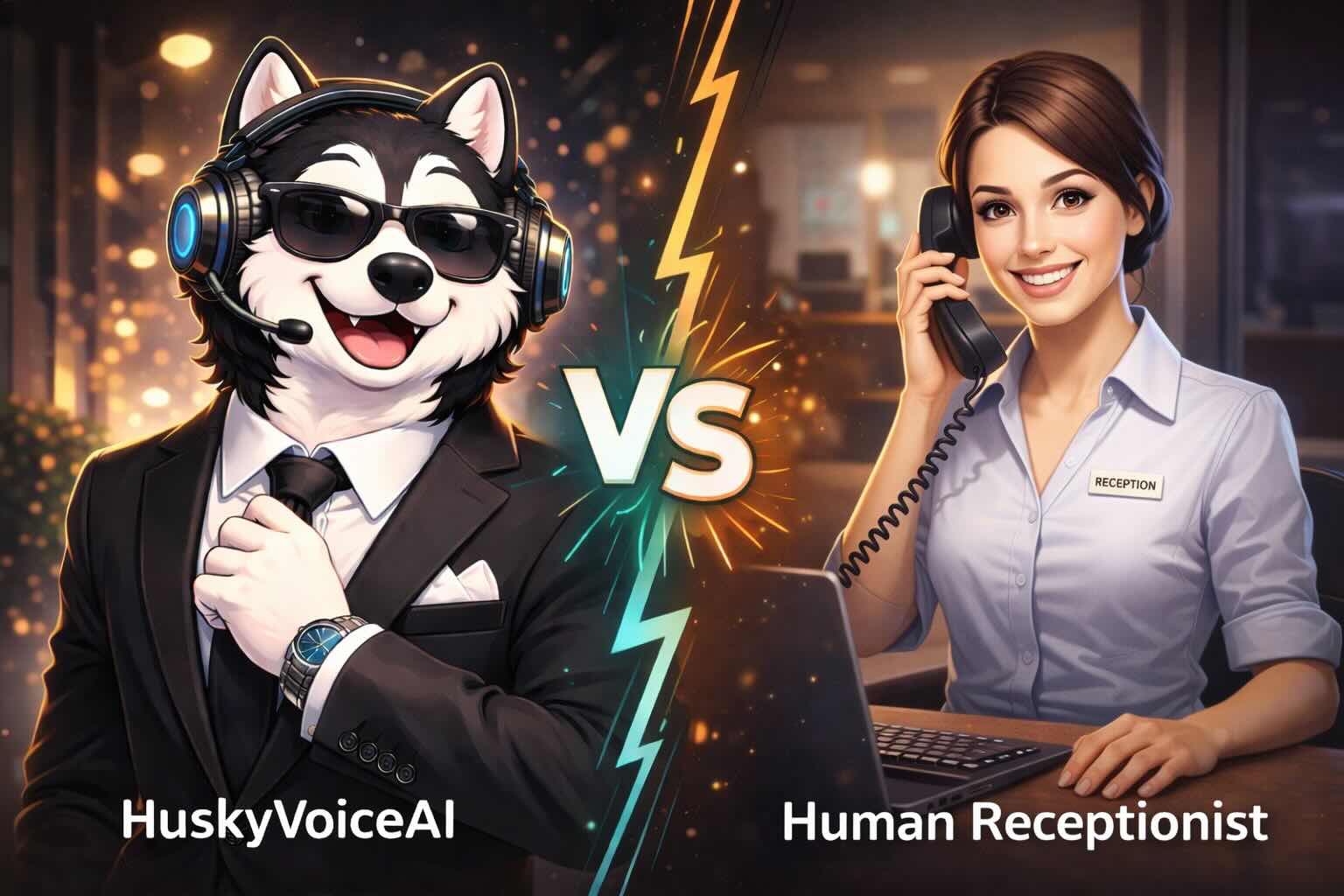
“Can an AI receptionist answer calls for my HVAC company?”
Yes.
But that is probably the wrong question.
Almost any modern AI receptionist can pick up the phone, greet the caller, and answer a few basic questions.
The more important question is:
Can it actually move an HVAC service call forward?
A homeowner does not call because they want to experience your phone system.
They call because:
- their AC stopped cooling
- their furnace is not working
- they need maintenance
- they want an estimate
- they need to reschedule
- they want to know when the technician is arriving
- they have a billing or service question
A useful AI receptionist needs to do more than answer.
It needs to understand why the customer called, collect the right information, take an appropriate action, and know when a human should step in.
For an HVAC company, that is the difference between an AI demo and an actual business system.
An HVAC AI Receptionist Is Not Just a Smarter Voicemail
Traditional voicemail has one job:
capture a message.
A traditional answering service may go one step further:
capture the customer’s name, number, and reason for calling.
That can be useful.
But modern Voice AI makes a broader workflow possible.
For example:
Customer calls
↓
AI understands the request
↓
Relevant information is collected
↓
Customer intent is identified
↓
Appointment is booked or next action determined
↓
Call is routed when needed
↓
Structured information is sent to the office team
That is the standard HVAC companies should be evaluating.
The question is no longer:
“Did someone answer?”
It is:
“What happened because the call was answered?”
1. It Should Understand Why the Customer Is Calling
The first capability sounds obvious.
It is also one of the most important.
HVAC customers do not speak in neat menu options.
They do not say:
“Cooling repair, option three.”
They say:
“My upstairs AC has been running all day but it’s still 82 degrees.”
Or:
“There’s water around the furnace.”
Or:
“We’re buying a house and want to replace the entire system.”
Or:
“I have an appointment tomorrow, but I need to move it.”
The AI needs to understand natural language and classify the intent.
Common HVAC call types might include:
- AC repair
- heating repair
- maintenance
- installation
- replacement estimate
- indoor air quality
- thermostat issue
- appointment changes
- technician-status questions
- billing
- maintenance-plan questions
- urgent escalation
- general questions
The system should not require customers to learn how to talk to it.
It should understand the way customers already talk.
2. It Should Capture the Information Your Team Actually Needs
Once the AI understands the reason for the call, it should gather enough information for the next step.
For a new service request, that may include:
- customer name
- phone number
- service address
- ZIP code
- existing or new customer
- type of equipment
- basic description of the issue
- when the problem started
- preferred appointment window
For an estimate request, the questions may be different:
- property location
- replacement vs new installation
- current system
- approximate age of equipment
- project timeline
- homeowner status
- appointment preference
The exact questions should be configurable.
Your HVAC business should define what information matters.
The AI should collect it consistently.
3. It Should Recognize Service Calls Versus Sales Opportunities
This is a particularly important capability.
A customer saying:
“My AC stopped working.”
is a service request.
A customer saying:
“Our system is almost 20 years old and we’re thinking about replacing it.”
may be a valuable sales opportunity.
Those calls should not necessarily enter the same workflow.
A capable AI receptionist should distinguish between:
Service
Problem → service qualification → appointment / dispatch
and:
Replacement or estimate
Project intent → sales qualification → estimate appointment / comfort advisor
That matters because replacement opportunities can have very different economics from routine repair calls.
Your phone workflow should recognize the difference.
4. It Should Know Your Service Area
One of the first things many HVAC businesses need to determine is whether the caller is actually inside the area they serve.
A customer may have found you through search, an old referral, or an advertisement.
The AI should be able to ask for:
- ZIP code
- city
- service address
and determine what happens next according to your service rules.
For example:
Inside primary service area
→ normal booking
Inside extended service area
→ additional rule or manual review
Outside service area
→ politely explain the limitation
That saves the office team from spending time qualifying geography manually.
5. It Should Be Able to Book an Appointment
For many HVAC companies, this is where an AI receptionist starts creating real operational value.
Suppose the AI handles the entire call but finishes with:
“Someone will contact you tomorrow to schedule.”
You still have another task.
Someone needs to:
- call back
- find availability
- speak with the customer
- choose a slot
- update the schedule
- send confirmation
A better workflow is:
“I can help schedule that now. We have tomorrow between 10 AM and noon or between 2 and 4 PM. Which works better?”
The customer chooses.
The appointment is booked.
That turns a call into an actual service event.
6. It Should Handle Appointment Changes Too
Booking new appointments is only part of the front-office workload.
Customers also call to:
- reschedule
- cancel
- ask about their appointment
- request a different time
- confirm the service window
A good HVAC AI receptionist should ideally be able to work with existing appointments, not only create new ones.
For example:
“I have an appointment tomorrow morning, but nobody will be home.”
The system can identify the appointment and, if the integration allows it, offer alternatives.
“Thursday afternoon or Friday morning are available. Would either work?”
This removes another repetitive task from the office team.
7. It Should Know When a Call Is Potentially Urgent
HVAC calls are not all equal.
Someone asking about annual maintenance does not need the same workflow as someone reporting something that may be unsafe.
Businesses should define clear escalation rules for situations involving issues such as:
- smoke
- burning smells
- suspected gas concerns
- major electrical concerns
- severe water leakage
- other company-defined safety scenarios
The AI should follow approved instructions.
It should not diagnose the equipment.
And it should not improvise technical safety advice.
Its job is to recognize that the normal workflow may no longer be appropriate and move the call to the correct escalation path.
8. It Should Transfer Calls to Humans When Needed
One of the worst ways to deploy AI is to make it impossible for customers to escape the automation.
Some calls simply need a person.
For example:
“I’ve already had two technicians out and the problem still isn’t fixed.”
“I need to speak with the service manager.”
“This is a large commercial property.”
“I want to discuss replacing three units.”
“I have a complicated billing issue.”
Or simply:
“Can I speak with someone?”
The system should support a clear human handoff.
Depending on the HVAC business, that could mean routing to:
- receptionist
- dispatcher
- service manager
- salesperson
- on-call technician
- billing team
The AI should help humans by capturing context before the transfer.
The customer should not need to start from the beginning.
9. It Should Answer Routine HVAC Business Questions
Not every caller needs service immediately.
Customers ask questions like:
“Do you service heat pumps?”
“Do you work in my ZIP code?”
“Do you offer weekend appointments?”
“Do you install new systems?”
“Do you work on commercial properties?”
“What time do you open?”
“Do you offer maintenance plans?”
A useful AI receptionist should be able to answer approved business FAQs.
That reduces routine front-desk interruptions.
But the word approved matters.
You do not want the AI inventing:
- pricing
- warranty terms
- technical diagnoses
- discounts
- arrival promises
- service policies
The system should be conversational while remaining grounded in information provided by the HVAC company.
10. It Should Understand Existing Customers
The experience becomes significantly better when the AI can connect the phone conversation to customer data.
If the caller’s number matches an existing record, the system may be able to identify context such as:
- customer name
- property
- existing appointment
- previous service
- maintenance-plan status
- open request
Then instead of starting every conversation with:
“Can I get your full information?”
the interaction can become more contextual.
For example:
“I see you have an appointment scheduled for tomorrow. Are you calling about that visit?”
This saves time for both the customer and the office.
11. It Should Integrate With the Systems Your HVAC Business Already Uses
This is where AI receptionist evaluations often become too focused on the voice.
The voice may sound excellent.
But what happens after the conversation?
If your team still needs to copy information manually from an AI dashboard into another system, you have created a new administrative step.
The stronger setup is:
Phone conversation → structured information → existing operational system
Depending on the business, that may involve:
- CRM
- field-service management system
- dispatch software
- scheduling platform
- customer database
- Google Sheets
- custom backend
The specific integration options vary by platform.
The important thing to evaluate is whether the Voice AI can communicate with the rest of your workflow through integrations, APIs, or webhooks.
12. It Should Turn Calls Into Structured Data
A transcript is useful.
A recording is useful.
But your dispatcher does not want to listen to a six-minute recording before deciding what to do.
A more useful output might be:
Customer: New customer
Intent: AC repair
Location: Within service area
Equipment: Central AC
Issue: Running but not cooling
Started: This afternoon
Preferred appointment: Tomorrow morning
Urgency: Standard
Appointment: Booked
Human follow-up: Not required
Or:
Customer: Existing customer
Intent: Replacement estimate
System age: Approximately 17 years
Project timeline: Within 30 days
Appointment: Sales consultation requested
Priority: High-value opportunity
Now the conversation can feed:
- dispatch
- sales
- CRM
- reporting
- automated follow-up
This is where Voice AI becomes more than a phone experience.
It turns unstructured conversation into structured operational data.
13. It Should Handle After-Hours Calls Differently
The workflow at 2 PM may not be the same as the workflow at 10 PM.
During business hours:
AI → collect → book → transfer where needed
After hours:
AI → collect → determine urgency → book next availability or trigger on-call rules
An HVAC company should be able to configure different behavior based on:
- office hours
- after-hours availability
- weekends
- holidays
- on-call coverage
That makes the AI fit the business rather than forcing the business into a generic workflow.
14. It Should Handle Overflow During Seasonal Spikes
One of the strongest use cases for Voice AI in HVAC is not full replacement.
It is overflow.
Imagine a heat wave.
Every office employee is already talking to a customer.
Another call arrives.
Instead of ringing indefinitely or going to voicemail:
AI answers.
That means the business can maintain responsiveness during unusually high demand without permanently staffing for peak volume.
A practical model may be:
Human-first → AI overflow
rather than:
AI handles everything.
For many HVAC businesses, that may be the better starting point.
15. It Should Support Outbound Calls Too
Inbound answering solves one side of the phone workflow.
But HVAC businesses also make outbound calls.
For example:
- missed-call callbacks
- appointment reminders
- maintenance reminders
- estimate follow-ups
- unsold estimate follow-ups
- membership renewal reminders
- customer feedback
- seasonal tune-up campaigns
Using the same Voice AI infrastructure for inbound and outbound workflows can make the system more useful over time.
A missed inbound call could trigger an outbound callback.
An upcoming appointment could trigger a reminder.
A customer due for maintenance could receive a proactive call.
The phone becomes part of a larger customer workflow.
What an HVAC AI Receptionist Should Not Do
A good evaluation also needs clear boundaries.
An AI receptionist should not be expected to independently:
Diagnose equipment
“The compressor definitely failed.”
That requires a qualified technician and proper inspection.
Invent prices
If exact pricing is not available in the approved business information, it should not guess.
Make unsupported safety decisions
Potentially unsafe situations should follow predefined company protocols.
Argue with upset customers
A frustrated customer may need a manager.
Prevent human contact
Customers should have an escalation path.
Overpromise technician availability
The system should only offer availability it can actually verify.
AI works best when its role is clear.
A Practical HVAC Call Example
Consider this conversation.
Customer:
“Hi, my AC has been running for hours but the house isn’t cooling down.”
AI:
“I can help with that. Are you calling about a residential property?”
Customer:
“Yes.”
AI:
“Thanks. What ZIP code is the property in?”
The customer provides it.
The system confirms that the location is within the service area.
AI:
“Is the system running but blowing warm air, or is it not turning on?”
Customer:
“It’s running. The air just isn’t cold.”
The system captures:
Intent: AC repair
Issue: Running, not cooling
Service area: Valid
Then:
“Would you like the earliest available appointment?”
“Yes.”
The AI checks availability.
“We have tomorrow between 9 and 11 AM or between 1 and 3 PM.”
“9 to 11.”
The appointment is booked.
The office receives:
New AC repair — tomorrow, 9–11 AM
along with the captured customer details and conversation summary.
The AI did not diagnose the AC.
It did not replace the technician.
It simply turned an inbound phone call into a properly structured service appointment.
That is what businesses should be evaluating.
15 Questions to Ask an HVAC AI Receptionist Vendor
Before choosing a system, ask:
- Can it understand open-ended HVAC service requests?
- Can we create separate flows for repair, maintenance, and replacement estimates?
- Can it identify whether a caller is inside our service area?
- Can it identify existing customers?
- Can it book appointments?
- Can it reschedule appointments?
- Can it transfer calls to our team?
- Can we define urgent-call escalation rules?
- Can it handle after-hours calls differently?
- Can it work as overflow when our team is busy?
- Can it answer approved business FAQs?
- Can it integrate with our CRM or field-service workflow?
- Does it extract structured fields from calls?
- Can it trigger outbound follow-up workflows?
- Can we review summaries, transcripts, and recordings?
The voice should sound good.
But your buying decision should be based on the workflow.
Where HuskyVoiceAI Fits
HuskyVoiceAI can be configured as a Voice AI layer for HVAC phone workflows.
A typical flow can look like:
Customer calls
↓
AI understands intent
↓
Customer and service information captured
↓
Repair / maintenance / estimate / other request classified
↓
Business rules applied
↓
Appointment booked, workflow triggered, or human handoff initiated
↓
Structured information available for downstream systems
The same platform can also support outbound workflows such as follow-up calls, reminders, or callbacks.
The goal is not simply to replace the person who says:
“Thanks for calling.”
The goal is to connect the conversation with the actual work that needs to happen next.
The Bottom Line
An HVAC AI receptionist should not be evaluated as a talking phone tree.
It should be evaluated as part of your service operation.
Can it understand why customers call?
Can it collect the right information?
Can it distinguish a repair from a replacement opportunity?
Can it schedule?
Can it handle after-hours and overflow?
Can it route calls when people need to take over?
Can it push structured information into the systems your team already uses?
Those questions matter much more than whether the demo voice sounds impressive for 30 seconds.
The real test is simple:
When the customer hangs up, has the problem moved forward?
If the answer is yes, you are evaluating something much more useful than an answering service.