The phone rings at 9:40 PM.
A homeowner says:
“Our AC stopped working and the house is getting really hot. Can someone come tomorrow?”
Your office is closed.
Your technicians are off shift.
Nobody answers.
The customer calls the next HVAC company.
This is the after-hours problem in one sentence.
HVAC demand does not follow office hours.
Systems fail at night.
Furnaces stop working early in the morning.
Homeowners notice temperature problems after they return from work.
And during extreme weather, calls can continue long after the front desk has gone home.
For HVAC companies, that creates a difficult choice:
hire people to answer phones around the clock,
use a traditional answering service,
send customers to voicemail,
or find another way to provide a useful first response.
Increasingly, Voice AI can handle part of that gap.
Not by replacing technicians.
Not by diagnosing equipment.
But by answering the call, understanding what the customer needs, capturing the right information, and moving the request to the correct next step.
After-Hours Calls Are Not All Emergencies
One reason after-hours HVAC handling becomes complicated is that every caller sounds urgent to themselves.
But the calls can be very different.
One customer says:
“My AC stopped cooling.”
Another says:
“I want to schedule my annual maintenance.”
Another asks:
“Can you give me an estimate for replacing my furnace?”
Someone else says:
“I smell something burning.”
All four calls came after 8 PM.
But they should not receive the same response.
That means the job of an after-hours answering system is not simply:
pick up the phone.
It needs to understand:
Why is this person calling, and what needs to happen next?
The Traditional Option: Voicemail
Voicemail is simple.
It is also risky.
A typical message says:
“Please leave your name, number, and a brief message. Someone will return your call during normal business hours.”
That works when the customer is willing to wait.
But an HVAC customer with no cooling on a hot evening may not wait until tomorrow morning.
They search again.
They call another contractor.
And once that contractor books the appointment, your callback has much less value.
Voicemail captures messages.
It does not necessarily capture jobs.
The Other Traditional Option: A 24/7 Answering Service
Human answering services can solve some of this problem.
Someone answers the call.
They take the customer’s name and number.
They may collect the reason for the call.
They may contact an on-call technician according to predefined instructions.
For many HVAC companies, that model works well.
But there are limitations.
The answering service may not know enough about your business to answer common questions.
It may act primarily as a message-taking layer.
Appointment booking may require another step.
The information may need to be manually entered into your systems later.
And the cost or complexity can increase as call volume grows.
Voice AI introduces another model:
Instead of only taking the message, can the system complete more of the initial workflow?
What Should Happen When Someone Calls After Hours?
A useful after-hours HVAC workflow can begin with a simple question:
“How can I help you?”
Then the system determines the type of call.
For example:
Routine service request
“My AC is running but it isn’t cooling properly.”
The system can collect:
- customer name
- phone number
- service address
- ZIP code
- description of the issue
- preferred appointment time
Then it can book the next available service slot or create a structured request for the morning team.
Maintenance request
“I need to schedule a tune-up.”
That is even more straightforward.
The AI can check available appointments and book one directly.
Estimate request
“I need a quote for replacing our air conditioner.”
That can trigger a sales workflow:
- property location
- current system information
- project type
- timeline
- preferred estimate time
Then an estimate appointment can be scheduled.
Potentially urgent issue
“I smell something burning near the furnace.”
That should not flow through the same routine booking process.
The system should follow the safety and escalation instructions defined by the HVAC company and involve the appropriate human or emergency pathway where required.
The important point is:
after-hours answering should be based on intent and urgency, not simply time of day.
Voice AI Is Useful Because It Can Ask Follow-Up Questions
A static answering service message might record:
“AC isn’t working.”
That leaves the next employee with many unanswered questions.
A conversational system can ask:
“Is the unit running but not cooling, or does it appear completely off?”
“When did the issue start?”
“Is this for a residential or commercial property?”
“What is the service address?”
“Is there anything such as smoke, a burning smell, or another condition that seems unsafe?”
“What time would work best for a technician?”
The system still should not diagnose the equipment.
But it can gather enough context to make the next step far more efficient.
After-Hours Does Not Necessarily Mean Emergency Dispatch
This distinction can save a lot of unnecessary disruption.
If every nighttime caller gets transferred to an on-call technician, the technician becomes the answering service.
That defeats much of the purpose.
Instead, the workflow can classify calls.
For example:
Routine maintenance
→ book future appointment
Standard repair
→ book next available service slot
Replacement estimate
→ schedule comfort advisor / sales appointment
Billing question
→ capture request for office follow-up
Existing appointment question
→ provide or capture approved information
Safety-related or urgent escalation
→ follow the company’s defined escalation process
Now the human on-call team is involved only when their involvement is actually necessary.
This Protects the On-Call Technician Too
After-hours service often creates hidden internal costs.
The technician on call may receive interruptions for questions such as:
“What time do you open tomorrow?”
“Can I schedule maintenance?”
“Do you service my area?”
“I need to move my appointment.”
Those are not technical emergencies.
But if the phone system cannot distinguish between routine and urgent, everything becomes the technician’s problem.
A first-response AI layer can reduce that noise.
It lets the technician focus on situations that actually need technical attention.
A Good After-Hours Agent Should Know Your Business Rules
The AI should not decide its own operating policy.
The HVAC business defines the rules.
For example:
Service area: specific ZIP codes
Normal service hours: 8 AM–6 PM
After-hours availability: emergency service only
Maintenance: next business day onward
Replacement estimates: weekdays and Saturdays
Existing maintenance-plan customers: priority routing
Certain safety conditions: immediate escalation instructions
Then the AI follows those rules consistently.
This is an important part of implementing Voice AI well.
The technology should execute your operating model.
It should not invent one.
Appointment Booking Is What Makes After-Hours AI Much More Valuable
Imagine two experiences.
Experience A
Customer calls at 10 PM.
A system takes their information.
Someone calls them at 8:30 AM.
Nobody answers.
The office tries again later.
Experience B
Customer calls at 10 PM.
The AI collects the service details.
It says:
“We have an appointment available tomorrow between 9 and 11 AM or between 1 and 3 PM. Which would you prefer?”
The customer books the morning slot.
They receive confirmation.
The office arrives the next morning with the service request already scheduled.
The second experience removes uncertainty for both sides.
The homeowner knows help is coming.
The HVAC company has protected the lead.
The Same Workflow Can Handle Rescheduling
After-hours callers are not always new customers.
Someone may call at 8 PM and say:
“I have an appointment tomorrow morning, but I can’t be home.”
Without automation, that becomes another voicemail for the office.
A workflow-enabled AI agent may be able to:
- identify the customer
- locate the appointment
- check alternate availability
- reschedule
- confirm the new time
Again, the goal is not merely to answer.
It is to resolve routine work without waiting for the office to reopen.
What Should Happen With Existing Customers?
Existing customers can receive a more contextual experience if the Voice AI system connects to the business’s customer data.
For example:
“I see you have an appointment scheduled tomorrow afternoon. Are you calling about that visit?”
Or:
“It looks like we serviced this address recently. Is this related to the same system?”
This can reduce repetitive questions.
It can also help identify:
- maintenance-plan customers
- warranty-related calls
- repeat service issues
- existing appointments
That is where integrations begin to matter.
What About New Leads From Google Ads?
This is especially important for HVAC businesses spending on paid acquisition.
Imagine someone searches:
AC repair near me
Clicks your ad.
Calls your number.
It is 8:15 PM.
If the call goes unanswered, you may have paid to generate a lead for a competitor.
The advertising campaign did its job.
The website did its job.
The phone conversion failed.
That is why after-hours call handling should be considered part of lead conversion strategy, not merely customer support.
Marketing does not stop when the phone rings.
Seasonal Call Spikes Make After-Hours Coverage Even Harder
During normal weather, after-hours volume may be manageable.
Then a heat wave arrives.
The phone keeps ringing well into the evening.
A human answering team that works perfectly under normal conditions suddenly becomes overloaded.
This is one of the advantages of an AI-based overflow or after-hours layer.
Capacity can expand without staffing another entire shift.
That does not mean every call should be automated.
It means routine demand can be absorbed while humans remain available for the situations where they are most valuable.
Voice AI Can Also Help With Outbound Follow-Up the Next Morning
Not every after-hours conversation needs to be fully resolved immediately.
Suppose the caller has a complicated replacement project.
The AI collects:
- name
- address
- current equipment
- reason for replacement
- approximate timeline
- preferred callback time
The next morning, the system can trigger the appropriate follow-up workflow.
That might mean:
- assign a salesperson
- create a CRM opportunity
- schedule a callback
- send the call summary
- initiate an outbound follow-up
The value of the evening conversation continues after the call ends.
What Should the Office Team See the Next Morning?
They should not arrive to 17 voicemail recordings.
A more useful queue might look like:
New repair request
Customer: New
Issue: AC running but not cooling
Location: In service area
Appointment: 9–11 AM
Urgency: Standard
Replacement opportunity
Customer: Homeowner
Request: Heat pump replacement estimate
Timeline: Within one month
Appointment: Estimate requested
Sales follow-up: Needed
Existing customer
Request: Reschedule maintenance
New appointment: Thursday afternoon
Status: Completed
Escalated issue
Reason: Safety-related concern
Action: On-call workflow triggered
That is much easier to operate than an inbox full of messages.
AI Should Not Pretend Every Situation Can Wait
After-hours automation needs careful escalation design.
There may be situations involving potential safety concerns where the correct response is not:
“We’ll schedule someone tomorrow.”
The HVAC company should define the response rules for situations involving issues such as:
- smoke
- burning smells
- suspected gas concerns
- significant electrical concerns
- other conditions the company considers potentially unsafe
The AI should follow the company’s approved safety guidance and escalation process.
It should not diagnose the situation.
And it should not improvise technical or emergency advice.
Customer Frustration Is Another Reason to Escalate
Sometimes the equipment problem is not the main problem.
The customer may say:
“This is the third time I’ve called. Your technician was supposed to be here today.”
That is not a standard scheduling conversation anymore.
The customer may need a service manager.
A good Voice AI workflow should identify that the conversation is becoming sensitive and route it appropriately.
Automation works best when it understands its boundaries.
How to Start Without Changing Your Entire Phone System
An HVAC company does not need to begin with 24/7 AI handling every call.
A controlled rollout is often better.
Option 1: After-hours only
Office open
→ humans answer
Office closed
→ AI answers
This is probably the simplest starting point.
Option 2: After-hours plus overflow
Humans answer whenever available.
AI picks up calls when the team is busy or outside business hours.
Option 3: Only specific workflows
For example:
- maintenance booking
- estimate requests
- basic appointment changes
Everything else routes normally.
Start where the conversation is predictable.
Expand after learning what customers actually ask.
What Should You Measure?
Do not measure success only by:
Calls answered by AI
Measure what happened because those calls were answered.
Useful metrics include:
- after-hours calls received
- percentage successfully handled
- service requests captured
- appointments booked
- estimate opportunities created
- calls escalated to humans
- missed calls avoided
- next-day callbacks required
- lead-to-appointment conversion
- customer abandonment
Ultimately, the most important question is:
Did answering after hours create jobs or reduce operational work that would otherwise have been lost or delayed?
How Voice AI Fits Into the After-Hours Workflow
A practical Voice AI workflow can look like:
Customer calls after hours
↓
AI answers immediately
↓
Reason for call identified
↓
Customer and service details captured
↓
Urgency classified using business-defined rules
↓
Routine request → appointment / callback / next action
or
Escalation condition → appropriate human pathway
↓
Structured details stored and sent to the relevant team
That is a more useful model than thinking of Voice AI purely as an automated receptionist.
It is a first-response workflow.
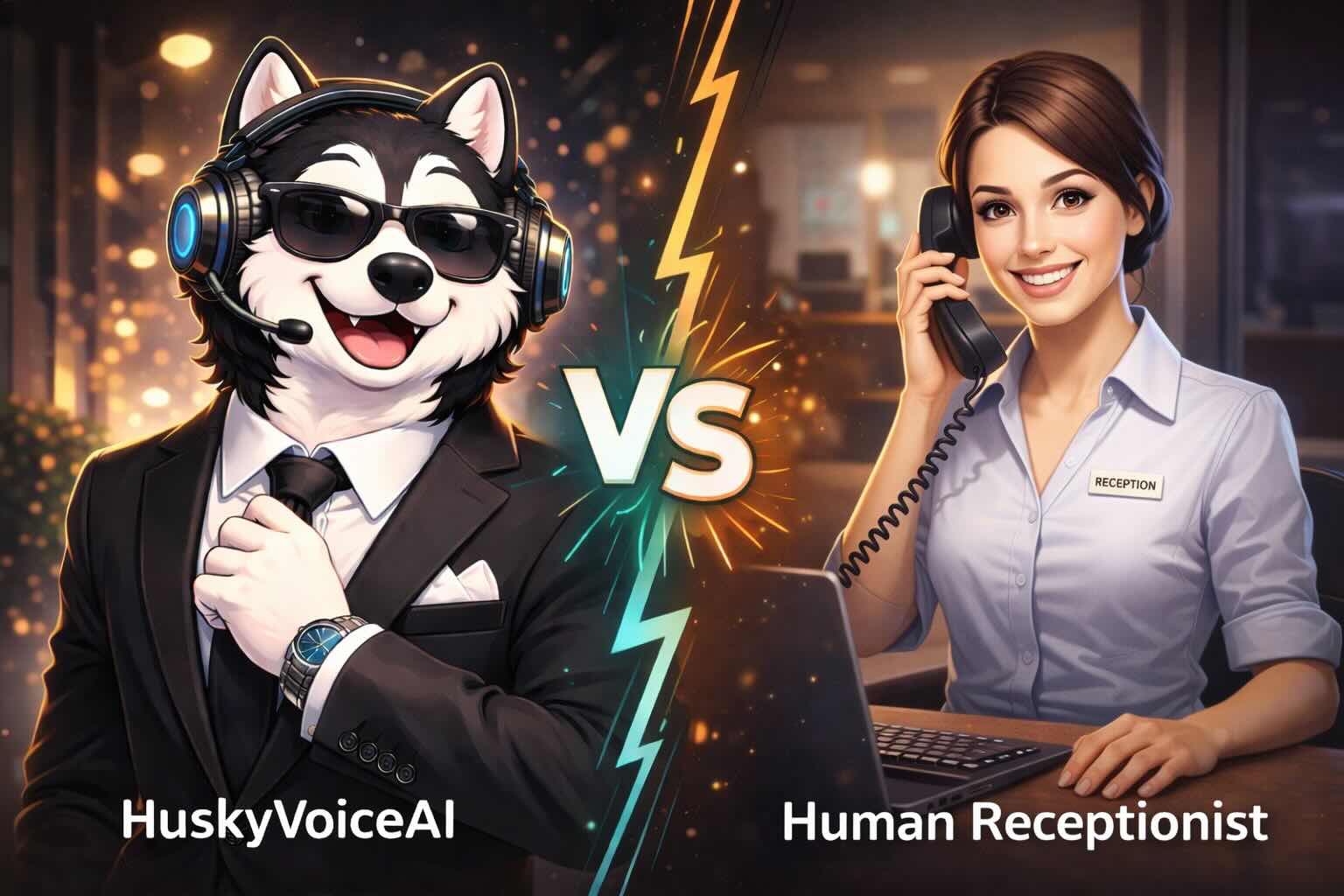
Where HuskyVoiceAI Fits
For HVAC companies, HuskyVoiceAI can be configured to handle inbound call workflows during after-hours or overflow periods.
Depending on the business process, the Voice AI agent can:
- answer incoming calls
- understand the customer’s reason for calling
- collect customer and property details
- identify repair, maintenance, estimate, or other intent
- follow business-defined routing rules
- schedule appointments where integrated
- trigger callbacks or downstream workflows
- transfer or escalate when human involvement is appropriate
- generate structured call summaries and outputs
The objective is not to automate HVAC expertise.
It is to automate the repetitive operational layer around the phone call.
The Bottom Line
Running a 24/7 HVAC call center is expensive.
Sending every after-hours customer to voicemail can also be expensive.
There is now a middle ground.
Routine calls can be answered immediately.
Service information can be captured.
Appointments can be scheduled.
Estimate opportunities can be preserved.
Urgent situations can follow defined escalation rules.
And the office team can start the next morning with structured work instead of a pile of voicemail messages.
For many HVAC businesses, that is the most practical way to think about after-hours Voice AI.
Not:
“Can AI replace my receptionist?”
But:
“What should happen when a customer calls and nobody in my office is available?”
If the answer today is simply “leave a message,” that may be one of the first workflows worth improving.